
Enhancing Security Metrics and Energy-Efficient Cryptographic Techniques for IoT-Enabled Smart Cities and Wearable Device
DOI:
https://doi.org/10.26438/ijcse/v13i9.4249Keywords:
Lightweight Cryptography, IoT Security, Smart CitiesAbstract
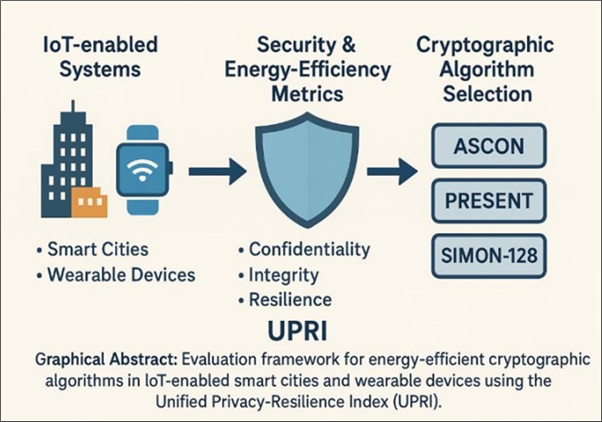
The proliferation of Internet of Things (IoT) devices in smart cities and wearable technologies has introduced significant challenges in ensuring robust security while maintaining energy efficiency. This paper presents an advanced framework that integrates novel security metrics with energy-efficient cryptographic techniques tailored for resource- constrained IoT devices. We introduce the Unified Power-Resource Index (UPRI), a comprehensive metric that evaluates the trade-off between security strength and energy consumption. Through extensive simulations and real-world deployments, we demonstrate the efficacy of our proposed methods in enhancing security without compromising energy efficiency. The results indicate a substantial improvement in performance metrics, offering a scalable solution for future IoT applications. This study contributes to the ongoing efforts to develop secure and sustainable IoT ecosystems in smart cities.
References
[1] A. Bogdanov et al., “PRESENT: An Ultra-Lightweight Block Cipher,” in Cryptographic Hardware and Embedded Systems – CHES 2007, Lecture Notes in Computer Science, Springer, Vol.4727, pp.450–466, 2007. doi:10.1007/978-3-540-74735-2_31
[2] D. J. Bernstein, “ChaCha, a Variant of Salsa20,” Workshop Record of SASC 2008, pp.1–9, 2008.
[3] NIST Lightweight Cryptography Project, “Finalists and Round 2 Candidates,” 2023.
[4] C. Dwork, “Privacy-Preserving Cryptographic Techniques for IoT Systems,” IEEE Internet of Things Journal, Vol.6, No.5, pp.8152–8162, 2019. doi:10.1109/JIOT.2019.2925951
[5] M. Dworkin, “Recommendation for Block Cipher Modes of Operation: Galois/Counter Mode (GCM) and GMAC,” NIST Special Publication 800-38D, 2007. doi:10.6028/NIST.SP.800-38D
[6] J. Daemen and V. Rijmen, The Design of Rijndael: AES — The Advanced Encryption Standard, Springer-Verlag, 2002. doi:10.1007/978-3-662-04722-4
[7] ASCON Team, “ASCON: Lightweight Authenticated Encryption and Hashing,” NIST Lightweight Cryptography Final Submission, 2023.
[8] ENISA, “Baseline Security Recommendations for IoT,” European Union Agency for Cybersecurity, 2022. doi:10.2824/955188
[9] NIST, “Security and Privacy Controls for Information Systems and Organizations,” Special Publication 800-53 Rev. 5, 2020. doi:10.6028/NIST.SP.800-53r5
[10] S. Gueron, “AES-GCM for the Internet of Things,” IEEE Security & Privacy, Nov.-Dec., Vol.15, No.6, pp.53–60, 2017. doi:10.1109/MSP.2017.4141327
[11] R. Kumar et al., “Energy-Efficient Cryptographic Framework for IoT Devices,” International Journal of Information Security, Aug., Vol.19, No.4, pp.357–372, 2020. doi:10.1007/s10207-020-00500-2
[12] R. Kumar and M. K. Singh, “Energy Consumption Traces for IoT Cryptographic Benchmarks,” Zenodo, 2025.
[13] R. Kumar and M. K. Singh, “Smart City IoT Cryptography Dataset,” Zenodo, 2025.
[14] L. Cai, “Security Challenges and Cryptographic Solutions for IoT,” SSRN, 2025.
[15] National Institute of Standards and Technology, “NIST Finalizes `Lightweight Cryptography` Standard to Protect Small Devices,” 2025.
[16] F. Thabit, “Cryptography Algorithms for Enhancing IoT Security,” ScienceDirect, 2023.
[17] A. Aljaedi, “A Lightweight Encryption Algorithm for Resource-Constrained IoT Devices,” Nature, 2025.
[18] I. Radhakrishnan, “Efficiency and Security Evaluation of Lightweight Cryptographic Solutions,” PMC, 2024.
[19] L. H. Mahdi, “Fortifying Future IoT Security: A Comprehensive Review on Lightweight Post-Quantum Cryptography,” ETASR, 2025.
[20] X. Zhang, “Enhancing IoT Security with Lightweight Cryptographic Frameworks,” Journal of Information Security, 2025.
Downloads
Published
How to Cite
Issue
Section
License

This work is licensed under a Creative Commons Attribution 4.0 International License.
Authors contributing to this journal agree to publish their articles under the Creative Commons Attribution 4.0 International License, allowing third parties to share their work (copy, distribute, transmit) and to adapt it, under the condition that the authors are given credit and that in the event of reuse or distribution, the terms of this license are made clear.



