
An Academic Review of the SIKE Attack in Post-Quantum Cryptography Failure
DOI:
https://doi.org/10.26438/ijcse/v13i8.6875Keywords:
Post-Quantum Cryptography, SIKE, Supersingular Isogeny Diffie-Hellman (SIDH), Cryptanalysis, Castryck-Decru Attack,, NIST, Elliptic Curves, Isogenies, Endomorphism RingsAbstract
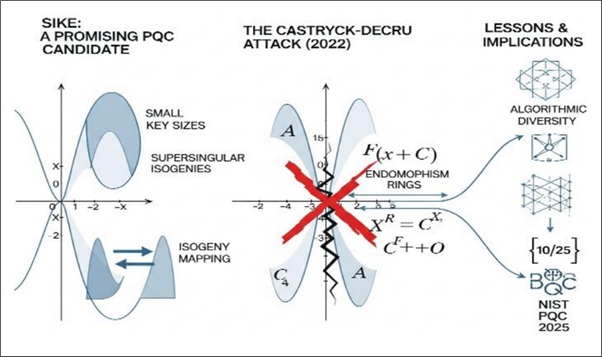
Supersingular Isogeny Key Encapsulation (SIKE) was a promising candidate in the National Institute of Standards and Technology (NIST) Post-Quantum Cryptography (PQC) standardization process, as it is distinguished by its exceptionally small key sizes, which makes it attractive for resource-constrained environments, and an elegant mathematical foundation rooted in supersingular elliptic curve isogenies. Its security based on the presumed hardness of computing isogenies between such curves. However, in August 2022, a groundbreaking attack by Castryck and Decru completely compromised SIKE, demonstrating its insecurity with practical polynomial-time complexity. This pivotal event led to SIKE`s immediate withdrawal from NIST`s standardization efforts, reshaping the evolving landscape of post-quantum cryptography and underscoring essential lessons in cryptographic design, evaluation, and diversity. A comprehensive academic analysis of the SIKE cryptographic scheme methodology and details of the specific nature of the Castryck-Decru attack that rendered it insecure is provided by this paper. It also discusses in brief the far-reaching implications for cryptographic design, standardization processes, and the pursuit of quantum-resistant algorithms, giving particular emphasis on the current state of post-quantum cryptography or PQC standardization as of 2025.
References
[1] National Institute of Standards and Technology, “Post-Quantum Cryptography Standardization: Announcement and Requirements”, Federal Register, December, Vol.81, No.244, pp. 92787--92788, 2016.
[2] National Institute of Standards and Technology, “NIST Post-Quantum Cryptography (PQC) Standardization Process: Status Update”, August 2022.
[3] J. De Feo, D. Jao, and J. Plut, “Towards quantum-resistant cryptosystems from supersingular elliptic curve isogenies”, in Post-Quantum Cryptography: 4th International Workshop, PQCrypto, Taipei, Taiwan, 2011.
[4] R. Azarderakhsh et al., “Supersingular Isogeny Key Encapsulation (SIKE)”, NIST Post-Quantum Cryptography Standardization Process, 2020.
[5] D. Jao, R. Azarderakhsh, M. Campagna, C. Costello, L. De Feo, B. Hess, A. Jalali, B. Koziel, B. LaMacchia, P. Longa, M. Naehrig, J. Renes, V. Soukharev, and D. Urbanik, “SIKE: Supersingular Isogeny Key Encapsulation”, NIST Post-Quantum Cryptography Standardization, Round 3 Submission, 2020.
[6] P. Stratil, S. Hasegawa, and H. Shizuya, “Supersingular Isogeny-based Cryptography: A Survey”, Cryptology Interdisciplinary Information Sciences, Vol.27, No.1, 2021.
[7] K. Naskar and A. Dey, “Foundations and Development of Isogeny-Based Cryptography: From Origins to the SIKE Collapse” International Journal of Computer Sciences and Engineering Vol.13, Issue.6, pp.23-31, 2025.
[8] W. Castryck and T. Decru, “An efficient key recovery attack on SIDH”, in CRYPTO 2022: 42nd International Cryptology Conference, Santa Barbara, CA, USA, Aug. pp.15-19, 2022.
[9] W. Castryck and T. Decru, “CSIDH on the surface”, in Post-Quantum Cryptography: 13th International Workshop, PQCrypto 2022, J. Ding and J.-P. Tillich, Eds. Cham: Springer International Publishing, pp. 111-129, 2022.
[10] “The SIKE teams acknowledges that
SIKE and SIDH are insecure and should not be used”. NIST Post-Quantum Cryptography-Round 4 Submissions: Public-key Encryption and Key-establishment Algorithms, History of Round 4 updates, 2017.
[11] J. Vélu, “Isogénies entre courbes elliptiques”, Comptes Rendus de l`Académie des Sciences, Série A et B, Vol.273, No.1, pp.55-58, 1971.
[12] A. Adj, L. Rivera-Zamarripa, and J. A. López-Ramos, “An attack on SIDH with arbitrary starting curve”, Cryptology ePrint Archive, pp.10-26, 2022.
[13] L. Maino and C. Martindale, “An attack on SIDH with arbitrary starting curve”, Cryptology ePrint Archive, 2022.
[14] D. Robert, “Breaking SIDH in polynomial time”, in Advances in Cryptology -- EUROCRYPT pp.472-503, 2023.
[15] National Institute of Standards and Technology, “Module-Lattice-Based Key-Encapsulation Mechanism Standard”, FIPS 203, 2024.
[16] National Institute of Standards and Technology, “Module-Lattice-Based Digital Signature Standard”, FIPS 204, August 2024.
[17] National Institute of Standards and Technology, “Stateless Hash-Based Digital Signature Standard”, FIPS 205, August 2024.
[18] J. Bos, L. Ducas, E. Kiltz, T. Lepoint, V. Lyubashevsky, J. M. Schanck, P. Schwabe, G. Seiler, and D. Stehlé, “CRYSTALS-Kyber: A CCA-secure module-lattice-based KEM”, in IEEE European Symposium on Security and Privacy, pp.353-367, 2018.
[19] L. Ducas, E. Kiltz, T. Lepoint, V. Lyubashevsky, P. Schwabe, G. Seiler, and D. Stehlé, “CRYSTALS-Dilithium: A lattice-based digital signature scheme”, IACR Transactions on Cryptographic Hardware and Embedded Systems, Vol.2018, No.1, pp.238-268, 2018.
[20] D. J. Bernstein, A. Hülsing, S. Kölbl, R. Niederhagen, J. Rijneveld, and P. Schwabe, “The SPHINCS+ signature framework”, in Proceedings of the 2019 ACM SIGSAC Conference on Computer and Communications Security, pp.2129-2146, 2019.
[21] T. Chou, “QcBits: Constant-time small-key code-based cryptography”, in Cryptographic Hardware and Embedded Systems – CHES, pp.280-300, 2016.
[22] C. Aguilar-Melchor, N. Aragon, S. Bettaieb, L. Bidoux, O. Blazy, J.-C. Deneuville, P. Gaborit, A. Hauteville, and G. Zémor, “HQC: Hamming Quasi-Cyclic”, NIST Post-Quantum Cryptography Standardization, Round 4 Submission, 2023.
[23] W. Beullens, J. De Feo, S. D. Galbraith, and C. Petit, “Proving knowledge of isogenies-A survey”, IACR Cryptology ePrint Archive, pp.671, 2023.
[24] W. Castryck, T. Lange, C. Martindale, L. Panny, and J. Renes, “CSIDH: An efficient post-quantum commutative group action”, in Advances in Cryptology -ASIACRYPT, pp.395-427, 2018.
[25] P. Longa, “A note on the security of CSIDH”, Cryptology ePrint Archive, pp.11-98, 2018.
[26] L. De Feo, D. Kohel, A. Leroux, C. Petit, and B. Wesolowski, “SQISign: Compact post-quantum signatures from quaternions and isogenies”, in Advances in Cryptology - ASIACRYPT, pp.64-93, 2020.
[27] D. Cervantes-Vázquez, M. Chenu, J.-J. Chi-Domínguez, L. De Feo, F. Rodríguez-Henríquez, and B. Smith, “Stronger and faster side-channel protections for PICNIC signatures”, in Progress in Cryptology - LATINCRYPT, pp.391-412, 2019.
Downloads
Published
How to Cite
Issue
Section
License

This work is licensed under a Creative Commons Attribution 4.0 International License.
Authors contributing to this journal agree to publish their articles under the Creative Commons Attribution 4.0 International License, allowing third parties to share their work (copy, distribute, transmit) and to adapt it, under the condition that the authors are given credit and that in the event of reuse or distribution, the terms of this license are made clear.



