
A Comprehensive Review of Fingerprint Recognition Systems, Methods, and Algorithms
DOI:
https://doi.org/10.26438/ijcse/v13i8.5867Keywords:
Biometric, Bozorth3, Otsu’s Thresholding, Gabor Filters, Feature Extraction, SegmentationAbstract
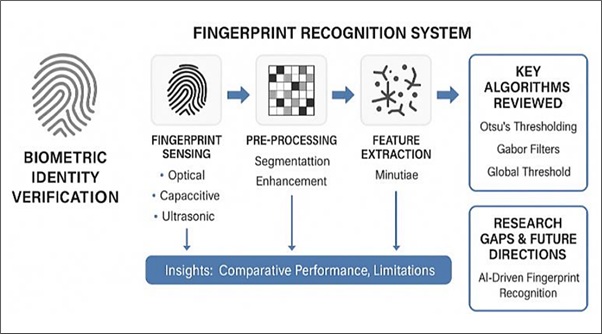
Today, we need security in every system, be it our personal laptop, computer system, ATM system, etc. We need to ensure that our data is well protected from misuse by imposters by verifying the identity of a user. Traditional systems of verification using credentials are not foolproof and face many challenges. These systems cannot meet the growing security demands in applications such as border crossing. Therefore, biometric recognition is becoming popular day by day. Biometrics is a way of verifying a user’s identity using innate traits that define the individual. This work gives a review of biometrics, particularly fingerprint recognition systems. The study also assesses popular methods, including the Bozorth3 algorithm, Otsu’s Thresholding, Gabor Filters, and Global Threshold Segmentation. There is a discussion of comparative insights into their limitations and performance. In addition to providing a comprehensive literature review, this paper identifies current research gaps and suggests potential directions for future advancements in fingerprint recognition technology.
References
[1] A. J. Abbey, “Fingerprint recognition system”, 2022.
[2] A. Z. Agha, R. K. Shukla, R. Mishra, R. S. Shukla, and P. Campus, “SSO Based Fingerprint Authentication of Cloud Services for Organizations”, 2023.
[3] S. S. Al-Amri and N. V. Kalyankar, “Image segmentation by using threshold techniques”, arXiv preprint, arXiv:1005.4020, 2010.
[4] F. Alonso-Fernandez, J. Bigun, J. Fierrez, H. Fronthaler, K. Kollreider, and J. Ortega-Garcia, “Fingerprint recognition”, Guide to Biometric Reference Systems and Performance Evaluation, pp.51–88, 2009.
[5] J. K. Appati, P. K. Nartey, E. Owusu, and I. W. Denwar, “Implementation of a Transform-Minutiae Fusion-Based Model for Fingerprint Recognition”, International Journal of Mathematics and Mathematical Sciences, Vol.2021, No.1, 2021.
[6] I. G. Babatunde, A. O. Charles, and O. Olatunbosun, “Uniformity level approach to fingerprint ridge frequency estimation”, International Journal of Computer Applications, Vol.62, No.22, 2013.
[7] R. Bansal, P. Sehgal, and P. Bedi, “Minutiae extraction from fingerprint images—a review”, arXiv preprint, arXiv:1201.1422, 2011.
[8] K. Bhargavi and S. Jyothi, “A survey on threshold based segmentation technique in image processing”, International Journal of Innovative Research and Development, Vol.3, No.12, pp.234–239, 2014.
[9] W. Bian, D. Xu, Q. Li, Y. Cheng, B. Jie, and X. Ding, “A survey of the methods on fingerprint orientation field estimation”, IEEE Access, Vol.7, pp.32644–32663, 2019. doi: 10.1109/ACCESS.2019.2903601.
[10] A. K. Chaubey, “Comparison of the local and global thresholding methods in image segmentation”, World Journal of Research and Review, Vol.2, No.1, pp.1–4, 2016.
[11] A. S. Chaudhari, G. K. Patnaik, and S. S. Patil, “Implementation of minutiae based fingerprint identification system using crossing number concept”, Informatica Economica, Vol.18, No.1, pp.17, 2014.
[12] W. El-Hajj-Chehade, R. A. Kader, R. Kassem, and A. El-Zaart, “Image segmentation for fingerprint recognition”, In the Proceedings of the IEEE Applied Signal Processing Conference (ASPCON), pp.314–319, 2018. doi: 10.1109/ASPCON.2018.8748534
[13] F. A. Fakhrina and M. Fakhry, “Fingerprint pattern feature extraction for loop fingerprint pattern identification by Zhang-Suen and Stentiford thinning method”, Journal of Computer Science and Information Technology, Vol.16, pp.84–91, 2024. doi: 10.18860/mat.v16i2.28892
[14] P. Gnanasivam and S. Muttan, “An efficient algorithm for fingerprint preprocessing and feature extraction”, Procedia Computer Science, Vol.2, pp.133–142, 2010.
[15] C. Gottschlich, “Curved-region-based ridge frequency estimation and curved Gabor filters for fingerprint image enhancement”, IEEE Transactions on Image Processing, Vol.21, No.4, pp.2220–2227, 2011. doi: 10.1109/TIP.2011.2170696
[16] P. M. A. Hambalík, “Fingerprint recognition system using artificial neural network as feature extractor: design and performance evaluation”, Tatra Mt. Math. Publ., Vol.67, pp.117–134, 2016.
[17] L. Hong, Y. Wan, and A. Jain, “Fingerprint image enhancement: algorithm and performance evaluation”, IEEE Transactions on Pattern Analysis and Machine Intelligence, Vol.20, No.8, pp.777–789, 1998. doi: 10.1109/34.709565
[18] A. K. Jain, A. Ross, and S. Prabhakar, “An introduction to biometric recognition”, IEEE Transactions on Circuits and Systems for Video Technology, Vol.14, No.1, pp.4–20, 2004. doi: 10.1109/TCSVT.2003.818349
[19] N. N. B. Karo, A. Y. Sari, N. Aziza, and H. K. Putra, “The enhancement of fingerprint images using Gabor filter”, In Journal of Physics: Conference Series, Vol.1196, No.1, 2019.
[20] M. Kuchana and A. Malneni, “Fingerprint matching—An experimental approach”, International Journal of Research in Applied Science and Engineering Technology, Vol.8, No.6, pp.1734–1742, 2020.
[21] C. Liu, V. K. Mago, R. Cappelli, M. Ferrara, and D. Maltoni, “Minutiae-based fingerprint matching”, Cross Disciplinary Biometric Systems, pp.117–150, 2012.
[22] W. Mao, Y. Zhao, P. Pavlenko, Y. Chen, and X. Shi, “Innovative solutions for worn fingerprints: A comparative analysis of traditional fingerprint impression and 3D printing”, Sensors, Vol.24, No.8, pp.2627, 2024.
[23] M. Mua’ad, Z. A. Alqadi, and K. Aldebei, “Comparative analysis of fingerprint features extraction methods”, Journal of Hunan University Natural Sciences, Vol.48, No.12, 2021.
[24] Z. Niu and H. Li, “Research and analysis of threshold segmentation algorithms in image processing”, In Journal of Physics: Conference Series, IOP Publishing, Vol.1237, No.2, pp.022122, 2019.
[25] T. Orczyk and L. Wieclaw, “Fingerprint ridges frequency”, In Third World Congress on Nature and Biologically Inspired Computing, IEEE, pp.558–561, 2011. doi: 10.1109/NaBIC.2011.6089649
[26] A. Pillai, S. Mil`shtein, and M. Baier, “Algorithms for binarizing, aligning and recognition of fingerprints”, In VISAPP, pp.426–432, 2011.
[27] B. M. Popovi?, M. V. Ban?ur, A. M. Rai?evi?, and D. Ran?elovi?, “Different methods for fingerprint image orientation estimation”, In 2012 20th Telecommunications Forum (TELFOR), IEEE, pp.662–665, 2012.
[28] N. Quadri and S. S. Choudhary, “Performance analysis and designing of fingerprints enhancement technique based on segmentation, of estimation and ridge frequency, Gabor filters with wavelet transform”, Image, Vol.16, pp.18, 2014.
[29] K. Rajaram, N. B. Amma, and S. Selvakumar, “Convolutional neural network based children recognition system using contactless fingerprints”, International Journal of Information Technology, Vol.15, No.5, pp.2695–2705, 2023.
[30] K. Sasirekha and K. Thangavel, “A comparative analysis on fingerprint binarization techniques”, International Journal of Computational Intelligence and Informatics, Vol.4, No.3, pp.163–168, 2014.
[31] M. A. Sidek, “Fingerprint recognition using gray level co-occurrence matrices (GLCM) and discrete wavelet transform (DWT)”, In IRC, 2015.
[32] S. A. Sudiro, I. P. Wardhani, B. A. Wardijono, and B. Handias, “Fingerprint matching application using hardware based artificial neural network with MATLAB”, In 5th International Conference on Electrical, Electronics and Information Engineering (ICEEIE), IEEE, pp.66–70, 2017, doi: 10.1109/ICEEIE.2017.8328764
[33] S. Supatmi and I. D. Sumitra, “Fingerprint matching using Bozorth3 algorithm and parallel computation on NVIDIA compute unified device architecture”, In IOP Conference Series: Materials Science and Engineering, IOP Publishing, Vol.879, No.1, pp.012109, 2020.
[34] Y. Wang, J. Hu, and F. Han, “Enhanced gradient-based algorithm for the estimation of fingerprint orientation fields”, Applied Mathematics and Computation, Vol.185, No.2, pp.823–833, 2007.
[35] R. Josphineleela and M. Ramakrishnan, “A new approach of altered fingerprints detection on the altered and normal fingerprint database”, Indian Journal of Computer Science and Engineering (IJCSE), Vol.3, No.6, pp.818–821, 2012.
[36] A. Sharma and M. Kaur, “Automatic segmentation for separation of overlapped latent fingerprints”, International Journal of Computer Sciences and Engineering, Vol.6, No.7, pp.484–490, 2018.
[37] P. E. Gundgurti and S. B. Kulkarni, “Latent fingerprint enhancement and segmentation through advanced deep-learning techniques”, International Journal of Computer Sciences and Engineering, Vol.16, No.1, pp.72–93, 2025.
Downloads
Published
How to Cite
Issue
Section
License

This work is licensed under a Creative Commons Attribution 4.0 International License.
Authors contributing to this journal agree to publish their articles under the Creative Commons Attribution 4.0 International License, allowing third parties to share their work (copy, distribute, transmit) and to adapt it, under the condition that the authors are given credit and that in the event of reuse or distribution, the terms of this license are made clear.



