
Languages Mapping Techniques Using Leaflet for Visualization of Dictionary Headwords
DOI:
https://doi.org/10.26438/ijcse/v13i8.4957Keywords:
Dictionary, Leaflet, Indo-European, Multilingual, VisualizationAbstract
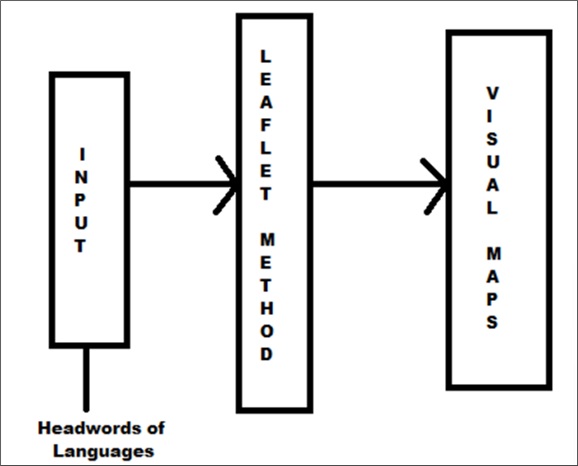
Dictionaries are generally the listing of lexemes from the lexicon of one or more languages with arranging of alphabets grammatically. The dictionary provides information about definitions, pronunciations, usage, translation, etymologies, etc. The Indian Languages are classified into 121 languages from the included constituent eighth schedule 22 languages and non-eighth schedule 99 languages. From the 121 languages are classified into family groups of Indo-European, Dravidian, Austro-Asiatic, Tibeto-Burmese and Semito-Hamitic. Learning through multiple Indian languages in a single platform with visually is one of the big tasks in any of the field. Visualization of multiple languages easily represented the states, language and their meanings easily explored in the form of maps.
References
[1] Tompkins, Gail E, “Language arts: Patterns of practice”, Upper Saddle River, NJ : Pearson Merrill/Prentice Hall, 2005.
[2] Tono Y, “Can a dictionary help one read better? On the relationship between EFL learners’ dictionary reference skills and reading comprehension”, In G. James (Ed.), Lexicographers and their works. Exeter: University of Exeter Press, 1989.
[3] Scholfield, P, “Vocabulary reference works in foreign language learning”, In N. Schmitt & M. McCarty (Eds.) Vocabulary: Description, acquisition, and pedagogy, Cambridge: Cambridge University Press, 1997.
[4] Schatz E & Baldwin R, “Context clues are unreliable predictors of word meanings. Reading Research Quarterly”, Vol.21, pp.439-453, 1986.
[5] Scherfer P, “Indirect L2 vocabulary learning. Linguistics”, Vol.31, pp.1141-1153, 1993
[6] Scott J. A & Nagy W. E “Understanding the definitions of unfamiliar verbs. Reading Research Quarterly”, pp.184–200, 1997.
[7] Shen. L, “Computer Technology and College Students’ Reading Habits”, Chia-nan annual bulletin, Vol.32, pp.559-572, 2006.
[8] Shen, Z. “The roles of depth and breadth of vocabulary knowledge in EFL reading performance”. Asian Social Science, Vol.4, Issue.12, pp.135-137, 2008.
[9] Shi, Z.L, “A comparative study of three learning strategies in EFL students incidental vocabulary acquisition.”, CELEA Journal, Vol.31, Issue.6, pp.91-101, 2008.
[10] Spencer, P. & Lederberg, A, “Different modes, different models: Communication and language of young Deaf children and their mothers”, In L. Adamson and M. Romski (Eds.) Communication and Language: Discoveries from atypical development. Baltimore: Paul H. Brookes, pp.203- 230, 1997.
[11] Albu, Elena, “Description versus rejection in the analysis of negation: Evidence from Romanian and English”, Lingua. 191–192. pp.22–41, 2017
[12] Anscombre, Jean-Claude & Ducrot, Oswald, “Deux mais en français?” Vol.43, Issue.1, pp.23–40, 1977.
[13] Blakemore, Diane, “Denial and Contrast: A Relevance Theoretic Analysis of "But"”. Linguistics and Philosophy, Vol.12, Issue.1, pp.15–37, 1989.
[14] Blakemore, Diane. “Relevance and linguistic meaning: The semantics and pragmatics of discourse markers”, Cambridge: Cambridge University Press. Vol.99, 2002
[15] Carston, Robyn, “The semantics/pragmatics distinction: A view from Relevance Theory”, In Turner, Ken (ed.), The semantics-pragmatics interface from different points of view, pp.85–125, 1999.
[16] Chen, Baoqin, “Xianqinlianci er yufayuyikaocha [Analysis of the syntactic and semantic properties of the connective er in Qin Dynasty]”, Guhanyuyanjiu [Studies on Classical Chinese]. Vol.22, Issue.1, pp.89–96, 1994.
[17] Dong, E., Du, H., & Gardner, L, “An interactive web-based dashboard to track COVID-19 in real time. The Lancet Infectious Diseases”, Vol.20, Issue.5, pp.533-534, 2020.
[18] Haklay, M., & Weber, P, “OpenStreetMap: A new paradigm for spatial data?”, International Journal of Spatial Data Infrastructures Research, 3, pp.1-23, 2008.
[19] Wu, H., Zhang, J., & He, H, “Development of a smart transportation monitoring dashboard using Leaflet and GPS data”, International Journal of Smart Transportation, Vol.2, Issue.1, pp.12-25, 2017.
[20] Hofer, C., Müller, F., & Richter, T. “Integrating real-time environmental data with Leaflet for dynamic visualization in environmental monitoring.”, Environmental Monitoring and Assessment, Vol.190, Issue.5, pp.317-330, 2018.
[21] Bowman, A., & Hodza, F. “Using Leaflet for classroom GIS learning: A low-entry barrier approach to geospatial education.” Journal of Geography in Higher Education, Vol.43, Issue.4, pp.549-561, 2019.
[22] Haklay, M., Basiouka, S., Antoniou, V., & Ather, A., “How good is volunteered geographic information? A comparative study of OpenStreetMap and Ordnance Survey datasets.”, Environment and Planning B: Planning and Design, Vol.37, Issue.4, pp.682-703, 2010.
[23] Dong, E., Du, H., & Gardner, L, “An interactive web-based dashboard to track COVID-19 in real time.”, The Lancet Infectious Diseases, Vol.20, Issue.5, pp.533-534, 2020.
[24] Bryson, B, “The Mother Tongue: English and How It Got That Way”, HarperCollins, 2014.
[25] Biedermann, H, “The Visual Dictionary of the Universe.”, DK Publishing, 2013.
[26] Weiner, E. “Oxford English–Spanish Dictionary”, Oxford University Press, 2018.
[27] Roget, P. M., “Roget’s Thesaurus of English Words and Phrases”, Longman, 1852.
[28] Hornby, A. S, “Oxford Advanced Learner’s Dictionary of Current English”, Oxford University Press, 2006.
[29] Academia Española “Diccionario de la lengua española (22nd ed.)”, Real Academia Española, 2001.
[30] Calkins, S. W., “The Oxford Dictionary of English Etymology”, Oxford University Press, 2012.
[31] Klein, E. “The New Encyclopedic Dictionary.”, McGraw-Hill, 2003.
[32] Zevenbergen, L., & Holmes, B. “Leaflet: A JavaScript Library for Interactive Maps.”, CartoDB, 2016.
[33] Butler, M, “GeoJSON: A format for encoding a variety of geographic data structures”, O`Reilly Media, 2011.
Downloads
Published
How to Cite
Issue
Section
License

This work is licensed under a Creative Commons Attribution 4.0 International License.
Authors contributing to this journal agree to publish their articles under the Creative Commons Attribution 4.0 International License, allowing third parties to share their work (copy, distribute, transmit) and to adapt it, under the condition that the authors are given credit and that in the event of reuse or distribution, the terms of this license are made clear.



