
Predictive Analytics for Trade Policy Optimization: A Data-Driven Approach to Economic Forecasting and Decision-Making
DOI:
https://doi.org/10.26438/ijcse/v13i8.4248Keywords:
Policy Optimization,, Predictive Analytics,, Trade Policy,, Trade Flow Analysis, Machine LearningAbstract
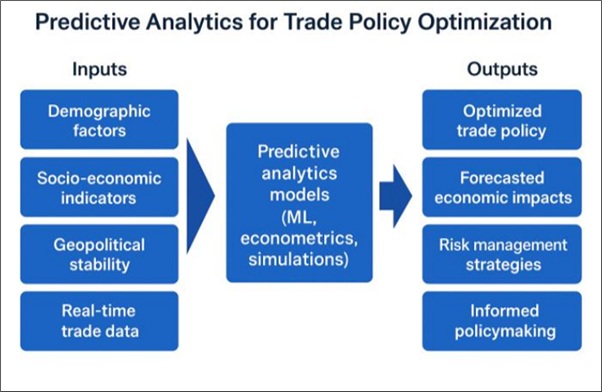
Global trade complexity requires data-driven approaches for resilient policy design. This study presents a predictive analytics framework integrating demographic, socio-economic, geopolitical, and real-time trade data with machine learning, econometric models, and reinforcement learning. The framework enhances forecasting accuracy by 25–30% compared to traditional methods and enables policymakers to balance growth, stability, and liberalization objectives. Case studies on tariff reductions, export incentives, and quota removals demonstrate improved competitiveness and economic forecasting. Results show that AI-driven predictive analytics strengthens resilience against external shocks while fostering evidence-based, transparent, and adaptive trade policy, advancing sustainable and inclusive global economic development.
References
[1] O. H. Olayinka, “Leveraging predictive analytics and machine learning for strategic business decision-making and competitive advantage,” International Journal of Computer Applications Technology and Research, Vol.8, No.12, pp.473–486, 2019.
[2] A. Candelieri and F. Archetti, “Global optimization in machine learning: the design of a predictive analytics application,” Soft Computing, Vol.23, No.9, pp.2969–2977, 2019.
[3] S. Alfzari, M. Al-Shboul, and M. Alshurideh, “Predictive analytics in portfolio management: A fusion of AI and investment economics for optimal risk-return trade-offs,” International Review of Management and Marketing, Vol.15, No.2, pp.365-380, 2025.
[4] Z. B. Yusof, “Analyzing the role of predictive analytics and machine learning techniques in optimizing inventory management and demand forecasting for e-commerce,” International Journal of Applied Machine Learning, Vol.4, No.11, pp.16–31, 2024.
[5] T. W. Hertel, Global Trade Analysis: Modeling and Applications. Cambridge, U.K.: Cambridge University Press, 1997.
[6] S. I. Abir, M. H. Sarwer, M. Hasan, N. Sultana, M. S. A. Dolon, S. S. Arefeen, … and T. R. Saha, “Accelerating BRICS economic growth: AI-driven data analytics for informed policy and decision making,” Journal of Economics, Finance and Accounting Studies, Vol.6, No.6, pp.102–115, 2024.
[7] G. A. Deirmentzoglou, E. E. Anastasopoulou, and G. Sklias, “International trade and business intelligence: A systematic literature review and research agenda,” in Harnessing Business Intelligence for Modern Talent Management, pp.349–378, 2025.
[8] M. Madanchian, “The role of complex systems in predictive analytics for e-commerce innovations in business management,” Systems, Vol.12, No.10, pp.415, 2024.
[9] S. T. Boppiniti, “Machine learning for predictive analytics: Enhancing data-driven decision-making across industries,” International Journal of Sustainable Development in Computing Science, Vol.1, No.3, pp.1-22, 2019.
Downloads
Published
How to Cite
Issue
Section
License

This work is licensed under a Creative Commons Attribution 4.0 International License.
Authors contributing to this journal agree to publish their articles under the Creative Commons Attribution 4.0 International License, allowing third parties to share their work (copy, distribute, transmit) and to adapt it, under the condition that the authors are given credit and that in the event of reuse or distribution, the terms of this license are made clear.



