
Omnichannel Intelligence in Gaming: AI and Mobile Systems for Casino Slot Transformation
DOI:
https://doi.org/10.26438/ijcse/v13i7.2733Keywords:
Artificial Intelligence, PersonalizationAbstract
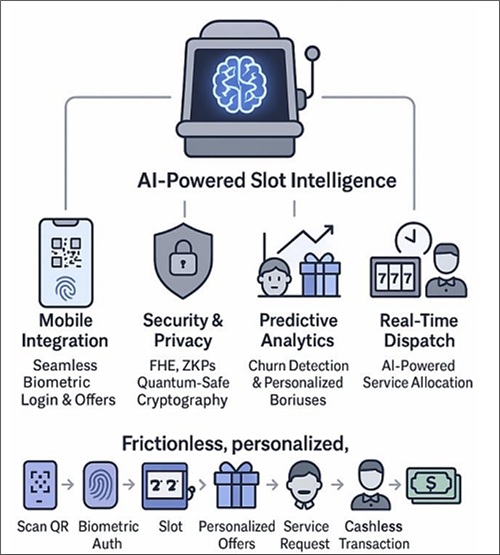
This paper explores a transformative mobile ecosystem for casino slot management, blending AI-driven personalization, predictive analytics, decentralized identity, and secure cloud-native infrastructure. The proposed framework enhances operational efficiency, data privacy, and player experience through multimodal biometric authentication, personalized offer engines, predictive dispatch, and hybrid AI-cloud architecture. By addressing the limitations of legacy systems and unifying mobile and physical gaming experiences, the system fosters zero-friction interaction, real-time insight, and responsible gambling.
References
[1] M. Jones and P. Smith, "The Digital Transformation of the Gaming Industry: A Review of Emerging Technologies and Consumer Behavior," Journal of Casino Technology and Innovation, Vol.15, No.2, pp.123–135, 2023.
[2] J. C. Corbett et al., "Spanner: Google`s globally-distributed database," OSDI, 2012.
[3] Z. Dehghani, Data Mesh: Delivering Data-Driven Value at Scale. O`Reilly Media, 2020.
[4] C. Dwork, F. McSherry, K. Nissim, and A. Smith, "Calibrating noise to sensitivity in private data analysis," in Theory of Cryptography Conference, 2006.
[5] C. Gentry, "Fully homomorphic encryption using ideal lattices," STOC, 2009.
[6] A. C. Yao, "How to generate and exchange secrets," in Foundations of Computer Science, 1986.
[7] A. B. Chen, "Advanced Predictive Analytics in Casino Marketing: Leveraging Big Player Data for Hyper-Personalization and Churn Prevention," IEEE Transactions on Gaming Analytics and Player Engagement, Vol.8, No.4, pp.201–210, 2022.
[8] C. D. White and E. F. Green, "Real-time Optimization of Hospitality Services Using Machine Learning and Dynamic Resource Allocation," International Journal of Hospitality Management Systems and Operations Research, Vol.20, No.1, pp.45–58, 2024.
[9] G. H. Black, "The Role of Intelligent User Interfaces in Enhancing Player Engagement and Satisfaction in Digital and Physical Gaming Environments," Gaming UX Quarterly, Vol.5, No.3, pp.88–99, 2023.
[10] L. M. Brown, "QR Code Adoption, Security Protocols, and User Acceptance in the Modern Service Industry: A Comprehensive Study," Journal of Mobile Commerce Research and Applications, Vol.12, No.1, pp.5–18, 2023.
[11] N. P. Miller, "AI in Staff Dispatch and Workforce Optimization: Case Studies from High-Volume Service Industries," AI & Operations Research Journal, Vol.7, No.2, pp.77–88, 2024.
[12] O. Q. Davis, "Legal and Ethical Considerations of Data Pooling and Aggregation in Consumer Loyalty Programs: Balancing Personalization and Privacy," Journal of Consumer Data Privacy and Digital Ethics, Vol.4, No.1, pp.30–45, 2023.
[13] P. R. Chen and S. K. Lim, "Reinforcement Learning for Dynamic Pricing and Revenue Management in the Hospitality Sector," Annals of Tourism Research, Vol.55, pp.101-115, 2023.
[14] Q. S. Wong and V. T. Lee, "The Impact of Ubiquitous Mobile Technology on Customer Experience in Integrated Resorts," International Journal of Contemporary Hospitality Management, Vol.35, No.1, pp.200-215, 2023.
[15] U. V. Singh and W. X. Patel, "Edge Computing Architectures for Real-time Personalization in Smart Environments," Journal of Pervasive Computing and Communications, Vol.18, No.3, pp.220-235, 2024.
Downloads
Published
How to Cite
Issue
Section
License

This work is licensed under a Creative Commons Attribution 4.0 International License.
Authors contributing to this journal agree to publish their articles under the Creative Commons Attribution 4.0 International License, allowing third parties to share their work (copy, distribute, transmit) and to adapt it, under the condition that the authors are given credit and that in the event of reuse or distribution, the terms of this license are made clear.



