
A Comparative Machine Learning Approach for Forecasting Student Achievement Based on Academic and Behavioral Features
DOI:
https://doi.org/10.26438/ijcse/v13i7.1826Keywords:
Academic Achievements, Machine Learning, Exam Score, Student Performance, SustainabilityAbstract
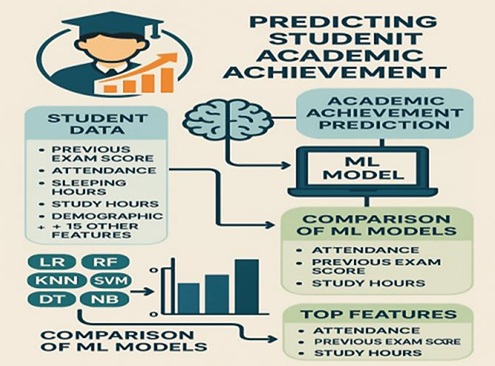
Forecasting student achievement is essential in educational environments to enhance academic success and reduce dropout rates. This research focused on improving student performance prediction through integrating advanced machine learning (ML) techniques. The dataset from Kaggle contains 20 features of the student`s academic, demographic, motivational, and other. The study showed a strong relationship between the students` academic achievement and their academic data, like previous exam scores, regularity, sleeping hours, study hours, and demographic features, as well as some other features. Students` academic achievement is predicted using the ML model. Then, these features were input into various ML models, such as LR, RF, KNN, SVM, DT, and NB. The experimental results show that the SVM model outperformed other models after applying hyperparameter tuning on the models and achieved the maximum classification accuracy of 0.9440. Also, a comparison of ML models evaluated through metrics has been presented. Also, graphical analysis shows that attendance, previous exam score, and study hours have a higher impact on a student’s academic achievement. This paper promotes the enhancement of quality education and the development of student skills as essential components for workforce advancement and sustainable industrialization, following the UN Sustainable Development Goals (SDGs) aims. By using this technique, teachers will enable students to monitor their academic progress according to their performance and adjust their study habits accordingly.
References
[1] Hassanbeigi, A., Askari, J., Nakhjavani, M., Shirkhoda, S., Barzegar, K., Mozayyan, M. R., & Fallahzadeh H., “The relationship between study skills and academic performance of university students”. Procedia-Social and Behavioral Sciences, Vol.30, pp.1416-1424, 2011.
[2] Muraina, M. B., Nyorere, I., Emana, I. E., & Muraina, K. O., “Impact of note taking and study habit on academic performance among selected secondary school students in Ibadan, Oyo State, Nigeria”. International Journal of Education and Research, Vol.2, Issue.6, pp.437-448, 2014.
[3] Cerna, M. A., & Pavliushchenko, K., “Influence of Study Habits on Academic Performance of International College Students in Shanghai”. Higher Education Studies, Vol.5, Issue.4, pp.42-55, 2015.
[4] Blasiman, R. N., Dunlosky, J., & Rawson, K. A., “The What, How Much, and When of Study Strategies: Comparing intended versus actual study behaviour”. Memory, Vol.25, Issue.6, pp.784-792, 2017.
[5] Rabia, M., Mubarak, N., Tallat, H., & Nasir, W., “A study on study habits and academic performance of students”. International Journal of Asian Social Science, Vol.7, Issue.10, pp.891-897, 2017.
[6] Tus, J., Lubo, R., Rayo, F., & Cruz, M. A. “The learners` study habits and its relation on their academic performance”. International Journal of All Research Writings, Vol.2, Issue.6, pp.1-19, 2020.
[7] Rahman, M. M., Watanobe, Y., Kiran, R. U., Thang, T. C., & Paik, I. “Impact of practical skills on academic performance: A data-driven analysis”. IEEE Access, Vol.9, pp.139975-139993, 2021.
[8] Al Husaini, Y. N. S., & Shukor, N. S. A., “Factors affecting students’ academic performance: A review”. RES MILITARIS, Vol.12, Issue.6, pp.284-294, 2022.
[9] Walck-Shannon, E. M., Rowell, S. F., & Frey, R. F., “To what extent do study habits relate to performance?”. CBE—Life Sciences Education, Vol.20, Issue.1, 2021.
[10] Barcenas, J. M. A., & Bibon, M. B., “The influence of study habits in the academic performance of senior high school students in Cagraray Island, Philippines”. Int. J. Sci. Res. in Multidisciplinary Studies Vol.8, Issue.1, 2022.
[11] Rubeena, Dr., “Study Habits and Its Effect on the Academic Performance of Grade XTh Students”. Review of Research in Education. 8. pp.1-5, 2019.
[12] Orji, F. A., &Vassileva, J., “Machine Learning Approach for Predicting Students Academic Performance and Study Strategies based on their Motivation”. arXiv preprint arXiv: 2210.08186, 2022.
[13] Bendangnuksung, P. P., “Students’ performance prediction using deep neural network”. International Journal of Applied Engineering Research, Vol.13, Issue.2, pp.1171-1176, 2018.
[14] Altabrawee, Hussein & Ali, Osama & Qaisar, Samir. “Predicting Students’ Performance Using Machine Learning Techniques”. Journal of University of Babylon for pure and applied sciences. Vol.27, pp.194-205, 2019. 10.29196/jubpas.v27i1.2108.
[15] Gajwani, J., & Chakraborty, P., “Students’ performance prediction using feature selection and supervised machine learning algorithms”. In International Conference on Innovative Computing and Communications: Proceedings of ICICC 2020, Springer Singapore. Vol.1, pp.347-354, 2021.
[16] Rai, S., Shastry, K. A., Pratap, S., Kishore, S., Mishra, P., & Sanjay, H. A. “Machine learning approach for student academic performance prediction”. In Evolution in Computational Intelligence: Frontiers in Intelligent Computing: Theory and Applications, FICTA 2020, Springer Singapore. Vol.1, pp.611-618, 2021.
[17] Bujang, S.D., Selamat, A., Ibrahim, R., Krejcar, O., Herrera-Viedma, E.E., Fujita, H., & Ghani, N.A. “Multiclass Prediction Model for Student Grade Prediction Using Machine Learning”. IEEE Access, 9, pp.95608-95621, 2023.
[18] Herrera-Viedma, E.E., Fujita, H., & Ghani, N.A. “Multiclass Prediction Model for Student Grade Prediction Using Machine Learning”. IEEE Access, 9, pp.95608-95621, 2023.
[19] Kale, R. A., & Rawat, M. K. (February). “Machine learning-based improvement in quality of learning using 4Q & S approach”. In 2022 Second International Conference on Artificial Intelligence and Smart Energy (ICAIS), IEEE, pp.284-289, 2022.
[20] Talla Sai Likhitha et al, “Student Academic Performance Prediction Using Machine Learning”. International Journal of Creative Research Thoughts, ISSN:2320-2882, 2022.
[21] Abulhaija, S., Hattab, S., &Etaiwi, W. (August). “Predicting Students` Performance Using Machine Learning”. International Conference on Information Technology (ICIT), IEEE, pp.470-475, 2023.
[22] Yadav, Nitin & Deshmukh, Sonal. “Prediction of Student Performance Using Machine Learning Techniques: A Review”. 2023. 10.2991/978-94-6463-136-4_63.
[23] Sri Lalitha Y et al, “An Efficient Novel Approach on Machine Learning Paradigms for Analysis and Prediction of Academic Performance Based On Student Behaviour Approach”, ECB, 2023, 10.48047/ecb/2023.12.si1o.00152
[24] Dhilipan, J., Vijayalakshmi, N., Suriya, S., & Christopher, A. (February). “Prediction of student’s performance using machine learning”. Conference series: Materials science and engineering, IOP Publishing, Vol.1055, No.1, pp.012122, 2021.
[25] Verma, U., Garg, C., Bhushan, M., Samant, P., Kumar, A., & Negi, A. (March). “Prediction of students’ academic performance using Machine Learning Techniques”. International Mobile and Embedded Technology Conference (MECON), IEEE, pp.151-156, 2022.
[26] Nedeva, V., & Pehlivanova, T., “Students’ performance analyses using machine learning algorithms in WEKA”. Conference Series: Materials Science and Engineering, IOP Publishing, Vol.1031, No.1, pp.012061, 2021.
[27] Rastrollo-Guerrero, J.L.; Gómez-Pulido, J.A.; Durán-Domínguez, A. “Analyzing and predicting students’ performance by means of machine learning: A review”. Appl. Sci., 10, pp.10-42, 2020.
[28] Chin, K. Y., Hong, Z. W., & Chen, Y. L., “Impact of using an educational robot-based learning system on students’ motivation in elementary education”. IEEE Transactions on Learning Technologies, Vol.7, Issue.4, pp.333–345, 2014.
[29] Stefanescu, Daniela, Emilia Herman, and Maria-Ana Georgescu. “Sustainable Development and Business Opportunities, Series: European Entrepreneurship Education”. Targu Mures: Petru Maior University of Targu Mures Printing House, 2009.
[30] Baghdadi, Y., Harfouche, A., & Musso, M., “ICT for an Inclusive World: Industry 4.0–Towards the Smart Enterprise”, Lecture notes in Information Systems and Organisation (LNISO), Springer, pp.35, 2020.
[31] Harfouche, A., Merhi, M. I., Albizri, A., Dennehy, D., & Thatcher, J. B. “Sustainable development through technological innovations and data analytics”. Information Systems Frontiers, Vol.26, Issue.6, pp.1989-1996, 2024.
[32] Junejo, N. U. R., Nawaz, M. W., Huang, Q., Dong, X., Wang, C., & Zheng, G., “Accurate multi-category student performance forecasting at early stages of online education using neural networks”. Scientific Reports, 15(1), 16251, 2025.
[33] Abdullah, M. W., Abu Agolah, R., Al Ajlouni, M., & Abdullah, M. “Predicting Students’ Online Exam Performance Using Machine Learning”. Proceedings of the 16th International Conference on Information and Communication Systems (ICICS). IEEE, 2025.
[34] Sandeepa, A. G. R., & Mohottala, S. (February). “Evaluation of Machine Learning Models in Student Academic Performance Prediction”. 5th International Conference on Advanced Research in Computing (ICARC), IEEE, pp.1-6, 2025.
[35] Althaqafi, T., Saleem, F., & AL-Ghamdi, A. A. M., “Enhancing student performance prediction: the role of class imbalance handling in machine learning models”. Discover Computing, 28(1), 79, 2025.
[36] Chen, J., Zhou, X., Yao, J., & Tang, S. K. “Application of machine learning in higher education to predict students’ performance, learning engagement and self-efficacy: a systematic literature review”. Asian Education and Development Studies, Vol.14, Issue.2, pp.205-240, 2025.
[37] Moubayed, A., Injadat, M., Alhindawi, N., Samara, G., Abuasal, S., & Alazaidah, R. (December). “A deep learning approach towards student performance prediction in online courses: Challenges based on a global perspective”. 24th International Arab Conference on Information Technology (ACIT), IEEE, pp.01-06, 2023.
[38] D. Boominath, S. Dhinakaran, “Analysis of Students Performance Prediction Models Using Machine Learning Approaches”, International Journal of Computer Sciences and Engineering, Vol.12, Issue.9, pp.9-13, 2024.
[39] N. Charuhasini, P. Drakshayani, P. Dhana Sri Aparna, P. Pravalika, Ch. Praneeth, “Analysing Privacy-Preserving Techniques in Machine Learning for Data Utility”, International Journal of Computer Sciences and Engineering, Vol.13, Issue.2, pp.64-70, 2025.
[40] Madaan, N., & Sharma, S. K. (October). An Efficient Model for Academic Performance Prediction of the University Students. In International Conference on Advancements in Smart Computing and Information Security, pp.149-163, 2024.
Downloads
Published
How to Cite
Issue
Section
License

This work is licensed under a Creative Commons Attribution 4.0 International License.
Authors contributing to this journal agree to publish their articles under the Creative Commons Attribution 4.0 International License, allowing third parties to share their work (copy, distribute, transmit) and to adapt it, under the condition that the authors are given credit and that in the event of reuse or distribution, the terms of this license are made clear.



