
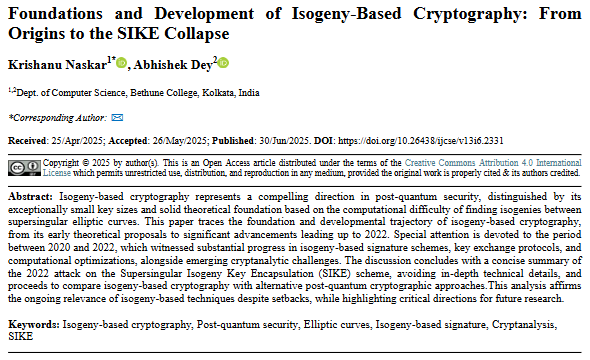
Foundations and Development of Isogeny-Based Cryptography: From Origins to the SIKE Collapse
DOI:
https://doi.org/10.26438/ijcse/v13i6.2331Keywords:
Isogeny-based cryptography, Post-quantum security, Elliptic curves, Isogeny-based signature, Cryptanalysis, SIKEAbstract
Isogeny-based cryptography represents a compelling direction in post-quantum security, distinguished by its exceptionally small key sizes and solid theoretical foundation based on the computational difficulty of finding isogenies between supersingular elliptic curves. This paper traces the foundation and developmental trajectory of isogeny-based cryptography, from its early theoretical proposals to significant advancements leading up to 2022. Special attention is devoted to the period between 2020 and 2022, which witnessed substantial progress in isogeny-based signature schemes, key exchange protocols, and computational optimizations, alongside emerging cryptanalytic challenges. The discussion concludes with a concise summary of the 2022 attack on the Supersingular Isogeny Key Encapsulation (SIKE) scheme, avoiding in-depth technical details, and proceeds to compare isogeny-based cryptography with alternative post-quantum cryptographic approaches.This analysis affirms the ongoing relevance of isogeny-based techniques despite setbacks, while highlighting critical directions for future research.
References
[1] L. De Feo, D. Kohel, A. Leroux, C. Petit, and B. Wesolowski, "SQIsign: Compact post-quantum signatures from quaternions and isogenies," IACR Cryptology ePrint Archive, 438, 2020.
[2] W. Castryck, T. Decru, and F. Vercauteren, "Radical Isogenies," IACR Cryptology ePrint Archive, 1108, 2020.
[3] L. De Feo, A. Leroux, P. Longa, and B. Wesolowski, "New algorithms for the Deuring correspondence: Towards practical and secure SQISign signatures," IACR Cryptology ePrint Archive, 234, 2022.
[4] K. Nakagawa and H. Onuki, "SQIsign2DPush: Faster Signature Scheme Using 2-Dimensional Isogenies," IACR Cryptology ePrint Archive, 897, 2025.
[5] S. Kim, Y. Lee, and K. Yoon, "Performance Evaluation of Isogeny-Based Digital Signature Algorithms: Introducing FIBS -- Fast Isogeny Based Digital Signature," The Journal of Supercomputing, 2025.
[6] J. Kim, C. Yoon, H. Jo, and J. H. Cheon, "New Hybrid Method for Isogeny-Based Cryptosystems Using Edwards Curves," IACR Cryptology ePrint Archive, 1215, 2018.
[7] S. Katsumata, Y. F. Lai, J. T. LeGrow, and L. Qin, "CSI-Otter: Isogeny-Based (Partially) Blind Signatures from the Class Group Action with a Twist," IACR Cryptology ePrint Archive, 1239, 2023.
[8] D. Beullens, L. De Feo, S. D. Galbraith, and C. Petit, "Proving knowledge of isogenies – A survey," IACR Cryptology ePrint Archive, 671, 2023.
[9] K. Cong, Y. F. Lai, and S. Levin, "Efficient isogeny proofs using generic techniques," IACR Cryptology ePrint Archive, 037, 2023.
[10] G. Su and G. Bai, "Towards High-Performance Supersingular Isogeny Hardware Accelerator Design," Electronics, Vol.12, No.5, pp.1235, 2023.
[11] M. El Baraka and S. Ezzouak, "Proposal of a New Isogeny-Based Cryptographic Protocol: Formal Analysis and Comparison," Mathematics Interdisciplinary Research, Vol.10, No.1, pp.111-132, 2025.
[12] D. Jao and L. De Feo, "Towards quantum-resistant cryptosystems from supersingular elliptic curve isogenies," IACR Cryptology ePrint Archive, 506, 2011.
[13] S. D. Galbraith, S. Barak, B. T. Yan, and C. Petit, "On the security of supersingular isogeny cryptosystems," IACR Cryptology ePrint Archive, 859, 2016.
[14] W. Castryck and T. Decru, "An efficient key recovery attack on SIDH," IACR Cryptology ePrint Archive, 975, 2022.
[15] A. Denis, "Side-channel attacks on SIKE," Master’s thesis, EPFL, 2023.
[16] L. De Feo et al., "SIKE channels: Zero-value side-channel attacks on SIKE," IACR Cryptology ePrint Archive, 54, 2022.
[17] F. Campos, M. Meyer, and S. Reith, "On Lions and Elligators: An Efficient Constant Time Implementation of CSIDH," IACR Cryptology ePrint Archive, 1198, 2018.
[18] D. J. Bernstein, A. Kizhakkumkara, T. Lange, and B. Wester, "On the hardness of computing endomorphism rings," IACR Cryptology ePrint Archive, 986, 2017.
[19] Y. Mokrani and D. Jao, "Generating supersingular elliptic curves over FP with unknown endomorphism ring," IACR Cryptology ePrint Archive, 984, 2023.
[20] NIST, "Status report on the fourth round of the PQC standardization process," NIST IR 8545, 2025.
[21] S. Du, X. Li, M. Lin, and R. Tang, "A Review of Chosen Isogeny-Based Cryptographic Schemes," Sensors, Vol.22, No.18, pp.7057, 2022.
[22] E. V. Flynn and Y. B. Ti, "Genus 2 isogeny cryptography," IACR Cryptology ePrint Archive, 177, 2019.
[23] P. Dartois et al., "SQIsignHD: New dimensions in cryptography," IACR Cryptology ePrint Archive, 436, 2023.
[24] C. Costello and B. Wester, "Fast and fault-tolerant isogeny-based key exchange," IACR Cryptology ePrint Archive, 1271, 2020.
Downloads
Published
How to Cite
Issue
Section
License

This work is licensed under a Creative Commons Attribution 4.0 International License.
Authors contributing to this journal agree to publish their articles under the Creative Commons Attribution 4.0 International License, allowing third parties to share their work (copy, distribute, transmit) and to adapt it, under the condition that the authors are given credit and that in the event of reuse or distribution, the terms of this license are made clear.



