
Sentiment Analysis on Social Media: A Transformer-Based Approach for Multilingual Data Insights
DOI:
https://doi.org/10.26438/ijcse/v13i6.1522Keywords:
Multilingual Sentiment Analysis, Transformer-Based Models, Social Media Analytics, Natural Language Processing (NLP) and BERT and mBERTAbstract
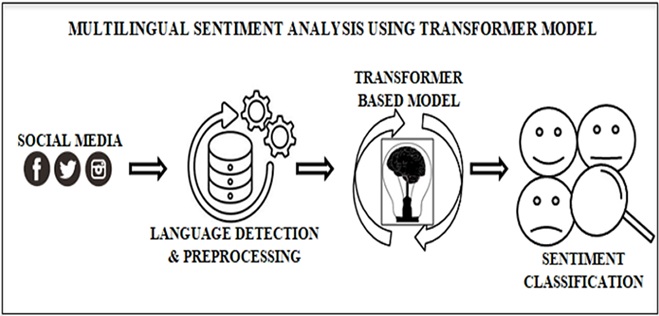
This is a study conducted on the perspective of doing the sentiment analysis about the user reviews on the transformer-based social media platforms. The main focus of this model will be multi-linguistic data as the social media platforms release a tremendous amount of user-generated multilingual data. Thus, NLP techniques become the inevitable part of using them since these will help in analysis across the varied linguistic contexts where his sentiments prevail. The transformerbased models, one as Bidirectional Encoder Representations from TransformersBERT and its multi-lingual form, have been demonstrated significant improvements over traditional sentiment analysis methods. This paper includes the issues in the management of mixed-language data from social media and the proposed methodology using transformer models to conduct sentiment classification. This paper is also meant to evaluate the very potential of the transformer-based techniques in enhancing sentiment analysis in several languages and to give insight into how well such models may work in different languages while performing the same tasks.
References
[1] Bing Liu, “Sentiment Analysis and Opinion Mining”, Springer Nature, India, pp.1-250, 2022.
[2] Israa Khalaf Salman Al-Tameemi, et al., “A Comprehensive Review of Visual–Textual Sentiment Analysis from Social Media Networks”, Journal of Computational Social Science, Vol.7, Issue.3, pp.2767-2838, 2024.
[3] Christian H., Suhartono D., Chowanda A., Zamli K. Z., “Text Based Personality Prediction from Multiple Social Media Data Sources Using Pre-Trained Language Model and Model Averaging”, Journal of Big Data, Vol.8, Issue.1, pp.1-12, 2021.
[4] Neeraj Anand Sharma, ABM Shawkat Ali, Muhammad Ashad Kabir, “A Review of Sentiment Analysis: Tasks, Applications, and Deep Learning Techniques”, International Journal of Data Science and Analytics, Vol.6, Issue.2, pp.1-38, 2024.
[5] Yongliang Wang, Ali Derakhshan, Ziwen Pan, “Positioning an Agenda on a Loving Pedagogy in Second Language Acquisition: Conceptualization, Practice, and Research”, Frontiers in Psychology, Vol.13, pp.1-12, 2022.
[6] Arghya Bhattacharya, “Breaking Language Barriers: A Study On Advancing Aspect-Based Sentiment Analysis for Low Resource Languages”, International Institute of Information Technology, India, pp.1-100, 2023.
[7] Sehgal, Sats. “Sentiment Analysis with Transformer Models with a Twist of Psychology.” Medium, Towards Data Science, 2021.
[8] Ansar, Wazib, Saptarsi Goswami, and Amlan Chakrabarti. "A Survey on Transformers in NLP with Focus on Efficiency." arXiv preprint arXiv:2406.16893, 2024.
[9] Pavel P?ibá?, Jakub Šmíd, Josef Steinberger, Adam Mištera, “A Comparative Study of Cross Lingual Sentiment Analysis”, Expert Systems with Applications, Vol.247, 2024.
[10] MA Bashar, Tahayna, “A Coherent Knowledge-Driven Deep Learning Model for Idiomatic-Aware Sentiment Analysis of Unstructured Text Using BERT Transformer”, Universiti Tunku Abdul Rahman, Malaysia, pp.1-85, 2023.
[11] Francisca Adoma Acheampong, Henry Nunoo-Mensah, Wenyu Chen, “Transformer Models for Text-Based Emotion Detection: A Review of BERT-Based Approaches”, Artificial Intelligence Review, Vol.54, Issue.8, pp.5789-5829, 2021.
[12] George Manias, et al., “Multilingual Text Categorization and Sentiment Analysis: A Comparative Analysis of the Utilization of Multilingual Approaches for Classifying Twitter Data”, Neural Computing and Applications, Vol.35, Issue.29, pp.21415-21431, 2023.
[13] Padmalal, et al., “Enhancing Sentiment Analysis in Social Media Texts Using Transformer-Based NLP Models”, International Journal of Computer Science and Applications, Vol.15, Issue.1, pp.22-30, 2024.
[14] Gazi Imtiyaz Ahmad, et al., “Machine Learning Techniques for Sentiment Analysis of Code-Mixed and Switched Indian Social Media Text Corpus: A Comprehensive Review”, International Journal of Advanced Computer Science and Applications, Vol.13, Issue.2, pp.150-160, 2022.
[15] Miah, Md Saef Ullah, et al. “A Multimodal Approach to Cross-Lingual Sentiment Analysis with Ensemble of Transformer and LLM.” Scientific Reports, 2024.
[16] Barakat AlBadani, et al., “Transformer-Based Graph Convolutional Network for Sentiment Analysis”, Applied Sciences, Vol.12, Issue.3, pp.1-12, 2022.
[17] Chiara Zucco, et al., “Sentiment Analysis for Mining Texts and Social Networks Data: Methods and Tools”, Wiley Interdisciplinary Reviews: Data Mining and Knowledge Discovery, Vol.10, Issue.1, pp.1-15, 2020.
[18] Jean, Guillaume. "Cross-Lingual Transfer Learning for Low-Resource NLP Tasks: Leveraging Multilingual Pretrained Models." 2023.
[19] K. Sangeetha, D. Prabha, “Sentiment Analysis of Student Feedback Using Multi-Head Attention Fusion Model of Word and Context Embedding for LSTM”, Journal of Ambient Intelligence and Humanized Computing, Vol.12, Issue.3, pp.4117-4126, 2021.
[20] A. Shaji George, T. Baskar, “Leveraging Big Data and Sentiment Analysis for Actionable Insights: A Review of Data Mining Approaches for Social Media”, Partners Universal International Innovation Journal, Vol.2, Issue.4, pp.39-59, 2024.
[21] Y. Qixuan, “Three-Class Text Sentiment Analysis Based on LSTM”, In the Proceedings of the 2024 International Conference on Artificial Intelligence and Data Science, China, pp.112-117, 2024.
[22] Y. Xie, “Sentiment Analysis of Xiaohongshu Texts Based on the RoBERTa Model”, Applied Computing and Engineering, Vol.11, Issue.2, pp.75-80, 2024.
[23] Dhanalakshmi, et al., “COVID-19 Twitter Data Analysis using LSTM and BERT Techniques”, International Journal of Engineering Trends and Technology, Vol.72, No.1, pp.45-52, 2024.
[24] X. Wang, “Analysis of Neural Networks in Text Sentiment”, Applied Computing and Engineering, Vol.76, pp.55-60, 2024.
[25] A. S. Talaat, “Sentiment Analysis Classification System Using Hybrid BERT Models”, Journal of Big Data, Vol.10, Issue.1, pp.12-19, 2023.
[26] K. Smitha, et al., “Deep Learning Approach for Sentiment-Based Rating Prediction”, International Journal of Cloud Computing and Database Management, Vol.5, Issue.2, pp.100-108, 2024.
[27] A. Sinha et al., “SEntFiN 1.0: Financial Sentiment Analysis Using finBERT and RoBERTa,” arXiv preprint, arXiv:2305.12257, 2023.
[28] N. Pookduang, et al., “Sentiment Analysis of Amazon Reviews Using RoBERTa”, Engineering, Technology & Applied Science Research, Vol.15, pp.50-58, 2025.
[29] D. Nayyar, N. Chandel, R. Kaur, “Enhanced RoBERTa-RNN Model for Sentiment Analysis”, Multimedia Tools and Applications, Vol.83, pp.18765–18784, 2024.
[30] H. A. Semary, et al., “Sentiment Analysis Using RoBERTa-CNN-LSTM”, Frontiers in Human Neuroscience, Vol.17, pp.1-10, 2023.
[31] A. Nkhata, et al., “Enhanced BERT-BiLSTM Model for Improved Sentiment Classification”, In the Proceedings of the 2025 International Conference on Artificial Intelligence Systems, South Africa, pp.89-94, 2025.
Downloads
Published
How to Cite
Issue
Section
License

This work is licensed under a Creative Commons Attribution 4.0 International License.
Authors contributing to this journal agree to publish their articles under the Creative Commons Attribution 4.0 International License, allowing third parties to share their work (copy, distribute, transmit) and to adapt it, under the condition that the authors are given credit and that in the event of reuse or distribution, the terms of this license are made clear.



