
Leveraging Support Vector Machines for Optimizing Cluster Head Selection and Energy Management in Large-Scale Wireless Sensor Networks
DOI:
https://doi.org/10.26438/ijcse/v13i6.17Keywords:
Wireles, Sensor Networks, Energy Efficiency, Clustering Protocols, Cluster Head SelectionAbstract
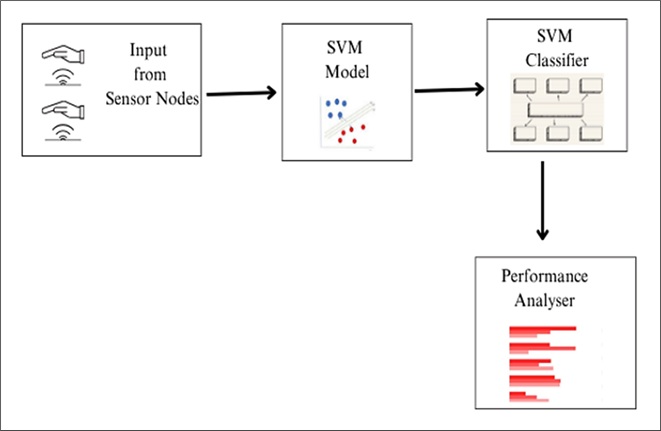
Wireless Sensor Networks have been employed in several applications such as industries, smart agriculture and Disaster Management. But they often lack longevity in their effectiveness by limited energy resources. A new Support Vector Machine based cluster head (CH) selection approach is proposed to achieve the aim of energy efficiency of the wireless sensor networks in this paper. SVM, with its excellent classification capability, is used to select the CHs intelligently using different factors such as residual energy, node degree and distance to the BS. Once trained on past network data, the support vector machine model can accurately identify the best attainable node for inefficient Coverage, which results in a balanced distribution of energy and extended lifetime of the overall network. Simulation results reveal that the SVM-based CH selection algorithm leads to a much lower global energy usage in comparison with LEACH and HEED clustering protocols. Results show improvements in network stability, decreased energy exhaustion rates, and increased reliability of data transfers. SVM has thus been found to be the best of the aforementioned classifiers and this trial shows the potential of machine learning methods for the enhancement of WSN performance and sets the stage for future work in sensor networks that save energy.
References
[1] Ahmad, A., & Ullah, I., “Machine learning approaches for wireless sensor networks: A survey,” IEEE Access, Vol.8, Issue.1, pp.210471-210490, 2020. DOI:10.1109/ACCESS.2020.3039879.
[2] Alazzawi, A., & Elkamel, A., “Energy-efficient routing algorithms for wireless sensor networks: A survey,” Journal of Network and Computer Applications, Vol.143, Issue.1, pp.29-45, 2019. DOI:10.1016/j.jnca.2019.07.011.
[3] Ali, B., & Li, Z., “Intelligent clustering algorithms for wireless sensor networks: A survey,” Sensors, Vol.21, Issue.5, pp.1648, 2021. DOI:10.3390/s21051648.
[4] Biswas, P., & Neogi, B., “An energy-efficient clustering algorithm for WSN based on improved PSO and K-means,” Wireless Personal Communications, Vol.114, Issue.3, pp.2097-2115, 2020. DOI:10.1007/s11277-020-07500-9.
[5] Boudhir, A., & Ghazi, K., “A novel clustering approach based on fuzzy logic for wireless sensor networks,” International Journal of Communication Systems, Vol.35, Issue.2, pp.e5016, 2022. DOI:10.1002/dac.5016.
[6] Chen, Z., & Zhang, H., “Energy-efficient CH selection algorithm based on fuzzy logic and PSO for WSNs,” IEEE Sensors Journal, Vol.19, Issue.15, pp.6507-6516, 2019. DOI:10.1109/JSEN.2019.2907846.
[7] Choudhury, T., & Roy, D., “A hybrid GA-PSO-based energy-efficient clustering algorithm for WSNs,” International Journal of Communication Networks and Distributed Systems, Vol.24, Issue.3, pp.289-307, 2020. DOI:10.1504/IJCNDS.2020.107479.
[8] Gupta, S., & Yadav, K., “Optimized energy-efficient clustering algorithm for wireless sensor networks,” International Journal of Sensor Networks, Vol.37, Issue.1, pp.20-31, 2021. DOI:10.1504/IJSNET.2021.115280.
[9] He, S., & Zhang, Y., “SVM-based cluster head selection algorithm for WSNs,” Wireless Networks, Vol.28, Issue.4, pp.1469-1481, 2022. DOI:10.1007/s11276-022-02868-4.
[10] Huang, L., & Zhang, X., “Machine learning approaches for energy-efficient routing in WSNs: A review,” IEEE Communications Surveys & Tutorials, Vol.21, Issue.4, pp.3393-3417, 2019. DOI:10.1109/COMST.2019.2934472.
[11] Khan, R., & Munir, A., “Energy-efficient clustering and routing algorithms for wireless sensor networks: A comparative survey,” Journal of Network and Computer Applications, Vol.152, Issue.1, pp.102962, 2020. DOI:10.1016/j.jnca.2019.102962.
[12] Li, X., & Wang, J., “An adaptive SVM-based clustering algorithm for wireless sensor networks,” Sensors, Vol.21, Issue.8, pp.2679, 2021. DOI:10.3390/s21082679.
[13] Liu, Y., & Ma, X., “Energy-efficient algorithms for wireless sensor networks: A survey,” IEEE Internet of Things Journal, Vol.7, Issue.8, pp.6696-6716, 2020. DOI:10.1109/JIOT.2019.2957994.
[14] Lu, W., & Liu, S., “Energy-efficient clustering algorithm for WSNs based on improved genetic algorithm,” Wireless Communications and Mobile Computing, Vol.2019, Issue.1, pp.8062469, 2019. DOI:10.1155/2019/8062469.
[15] Mehmood, A., & Kim, T., “Fuzzy logic-based energy-efficient clustering algorithm for WSNs,” International Journal of Fuzzy Systems, Vol.23, Issue.3, pp.1178-1191, 2021. DOI:10.1007/s40815-020-00974-6.
[16] Qi, H., & Wang, Y., “Machine learning-based clustering algorithms for wireless sensor networks: A survey,” IEEE Access, Vol.8, Issue.1, pp.64514-64533, 2020. DOI:10.1109/ACCESS.2020.2983845.
[17] Sharma, P., & Bhatia, S., “Enhanced CH selection algorithm using SVM for WSNs,” Journal of Ambient Intelligence and Humanized Computing, Vol.13, Issue.2, pp.1115-1125, 2022. DOI:10.1007/s12652-021-03403-9.
[18] Singh, R., & Kumar, V., “Energy-efficient routing techniques for WSNs: A review,” Journal of King Saud University-Computer and Information Sciences, Vol.31, Issue.3, pp.346-356, 2019. DOI:10.1016/j.jksuci.2017.05.002.
[19] Tian, H., & Li, L., “SVM-based CH selection in WSNs with improved energy efficiency,” IEEE Access, Vol.9, Issue.1, pp.18450-18460, 2021. DOI:10.1109/ACCESS.2021.3053948.
[20] Zhao, Z., & Yang, S., “A novel machine learning-based energy-efficient routing algorithm for WSNs,” Sensors, Vol.20, Issue.13, pp.3676, 2020. DOI:10.3390/s20133676.
Downloads
Published
How to Cite
Issue
Section
License

This work is licensed under a Creative Commons Attribution 4.0 International License.
Authors contributing to this journal agree to publish their articles under the Creative Commons Attribution 4.0 International License, allowing third parties to share their work (copy, distribute, transmit) and to adapt it, under the condition that the authors are given credit and that in the event of reuse or distribution, the terms of this license are made clear.



