
Lifecare: AI-Powered Healthcare Web App for Smarter Medical Services
DOI:
https://doi.org/10.26438/ijcse/v13i4.116120Keywords:
Healthcare, Diagnostic Assistance, Treatment Personalizatio, Data Privac, Ethical Consideration, Artificial Intelligence.Abstract
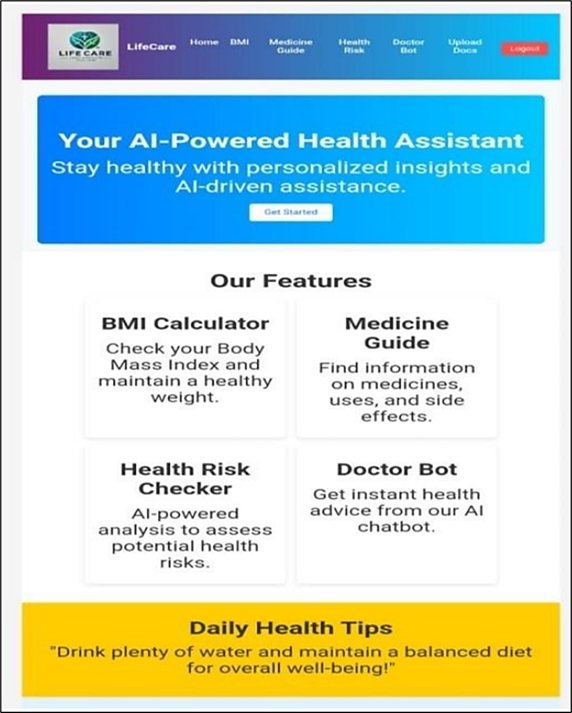
LifeCare is a cutting-edge AI-powered healthcare web application designed to enhance accessibility and streamline medical support. It enables users to check symptoms, connect with doctors through virtual consultations, track health data in realtime, and calculate their Body Mass Index (BMI) effortlessly. The platform leverages artificial intelligence to deliver personalized health insights, empowering users to make informed decisions. Secure and encrypted communication ensures that all interactions between patients and healthcare professionals are private and compliant with medical data protection standards. LifeCare features an intelligent symptom checker that offers preliminary health evaluations and recommendations. Users can consult with certified doctors online, helping to reduce unnecessary hospital visits. Advanced AI algorithms predict potential health issues early, promoting timely interventions and preventive care. Additional features include medication reminders, emergency alerts, and tailored health advice. Users can also access detailed information about medications, including their uses and potential warnings. By integrating modern technology and AI, LifeCare transforms traditional healthcare into a more proactive, data-driven, and userfriendly experience—ultimately improving the quality of patient care.
References
[1] P. McCorduck, Machines Who Think: A Personal Inquiry into the History and Prospects of Artificial Intelligence, CRC Press, 2004.
[2] E. Brynjolfsson, A. McAfee, The Second Machine Age: Work, Progress, and Prosperity in a Time of Brilliant Technologies, W. W. Norton & Company, New York, 2014.
[3] RAND Corporation, "Chronic Conditions in America: Price and Prevalence", RAND Review, 2017.
[4] Q. Lv, Y. Jiang, J. Qi, Y. Zhang, X. Zhang, L. Fang, et al., "Using Mobile Apps for Health Management: A New Health Care Mode in China", JMIR Mhealth Uhealth, Vol.7, Issue.6, pp.e10299, 2019.
[5] A. Snowdon, Digital Health: A Framework for Healthcare Transformation, GS1 Canada, 2020.
[6] O.D. Williams, "COVID-19 and Private Health: Market and Governance Failure", Development, Vol.63, pp.181–190, 2020.
[7] A.A. Tabriz, E. Nouri, H.T. Vu, V.T. Nghiem, B. Bettilyon, P. Gholamhoseyni, N. Kiapour, "What Should Accountable Care Organizations Learn from Health Maintenance Organizations?", Soc. Determ. Health, Vol.2, 2020.
[8] World Health Organization, "Naming the Coronavirus Disease (COVID-19) and the Virus that Causes It", WHO, 2020.
[9] I.Ahmed, H. Al-Muhtadi, "Artificial Intelligence Applications in the Pharmaceutical Sciences", Journal of Pharmaceutical Sciences, Vol.109, Issue.3, pp.789–797, 2020.
[10] E. Alpaydin, Introduction to Machine Learning, MIT Press, Cambridge, MA, 2020.
[11] A.F.U.R. Khilji, S.R. Laskar, P. Pakray, R.A. Kadir, M.S. Lydia, S. Bandyopadhyay, "Healfavor: A Chatbot Application in Healthcare", Analysis of Medical Modalities for Improved Diagnosis in Modern Healthcare, CRC Press, pp.41–61, 2021.
[12] S.M. Lee, D. Lee, "Opportunities and Challenges for Contactless Healthcare Services in the Post-COVID-19 Era", Technological Forecasting and Social Change, Vol.167, pp.120712, 2021.
[13] R. Goel, R.P. Goswami, S. Totlani, P. Arora, R. Bansal, D. Vij, "Machine Learning-Based Healthcare Chatbot", 2nd Int. Conf. on Advance Computing, Innovative Technologies in Engineering (ICACITE), IEEE, pp.188–192, 2022.
[14] I.D. Kocakoç, "The Role of Artificial Intelligence in Health Care", The Impact of Artificial Intelligence on Governance, Economics, Finance, Vol.2, Springer, pp.189–206, 2022.
[15] A. Alm, L.M. Nkomo, "Chatbot Experiences of Informal Language Learners: A Sentiment Analysis", Research Anthology on Implementing Sentiment Analysis Across Multiple Disciplines, IGI Global, pp.933–948, 2022.
[16] C.J.T. Butcher, W. Hussain, "Digital Healthcare: The Future", Future Healthcare Journal, Vol.9, Issue.2, pp.113–117, 2022.
[17] Y. Siriwardhana, G. Gür, M. Ylianttila, M. Liyanage, "The Role of 5G for Digital Healthcare Against COVID-19 Pandemic: Opportunities and Challenges", ICT Express, Vol.7, pp.244–252, 2022.
[18] T. Shakeel, S. Habib, W. Boulila, A. Koubaa, A.R. Javed, M. Rizwan, T.R. Gadekallu, M. Sufiyan, "A Survey on COVID-19 Impact in the Healthcare Domain", Complex Intelligent Systems, Vol.9, pp.1027–1058, 2022.
[19] P. Rajpurkar, E. Chen, O. Banerjee, E.J. Topol, "AI in Health and Medicine", Nature Medicine, Vol.28, pp.31–38, 2022.
[20] W.M. Carroll, "Digital Health and New Technologies", Nursing and Informatics for the 21st Century, 3rd ed., Productivity Press, pp.29–48, 2022.
[21] M.H. Abidi, A.U. Rehman, S.H. Mian, H. Alkhalefah, Y.S. Usmani, "The Role of AI in Elevating Hospital Service Quality", Modern Healthcare Marketing in the Digital Era, IGI Global, pp.211–224, 2024.
[22] A. Ahmadi, Digital Health Transformation: Leveraging AI for Monitoring and Disease Management, 2024.
Downloads
Published
How to Cite
Issue
Section
License

This work is licensed under a Creative Commons Attribution 4.0 International License.
Authors contributing to this journal agree to publish their articles under the Creative Commons Attribution 4.0 International License, allowing third parties to share their work (copy, distribute, transmit) and to adapt it, under the condition that the authors are given credit and that in the event of reuse or distribution, the terms of this license are made clear.



