
Sensor Selection for Air Quality Monitoring: Machine Learning-Based Calibration and Performance Comparison of IoT Devices for Gaseous Pollutant Elements
DOI:
https://doi.org/10.26438/ijcse/v13i4.8491Keywords:
Air Quality Index (AQI), I, IoT-based Gas Sensors,, Machine Learning Calibration,, Sensor Performance Evaluation, Random Forest RegressorAbstract
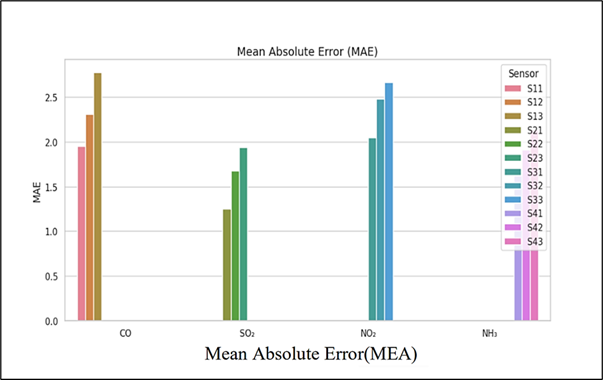
Air pollution is becoming a serious problem in cities, with direct impacts on both public health and the environment. Being able to predict the Air Quality Index (AQI) accurately and on time is important for taking steps to prevent or reduce pollution. This study explores the use of IoT-based gas sensors to help forecast AQI, focusing on four main pollutants: Carbon Monoxide (CO), Sulfur Dioxide (SO?), Nitrogen Dioxide (NO?), and Ammonia (NH?). Three different sensors were tested for each gas to see how well they performed. After calibrating the sensors, their readings were converted to parts per million (ppm), and artificial data was created to represent three months of half-hourly readings. A machine learning method, Random Forest Regressor, was used to check how accurate each sensor was, based on performance measures like MAE, RMSE, and R² Score. Sensor, referred as Sensor S1, gave the best results across all gases, showing better accuracy and reliability than the others. This research shows how important it is to choose and calibrate the right sensors for monitoring air quality and could help build better systems for predicting AQI in real time. The findings offer useful information for improving environmental monitoring with smart technology.
References
[1] Central Pollution Control Board, “National Air Quality Index (NAQI),” Ministry of Environment, Forest and Climate Change, Govt. of India, 2014.
[2] World Health Organization, “Air pollution,” 2023.
[3] S. Kumar, V. Singh, and A. K. Sharma, “Air quality prediction using machine learning techniques: A review,” Environmental Science and Pollution Research, Vol.29, pp.4259–4278, 2022.
[4] CPCB, “National Ambient Air Quality Standards (NAAQS),” 2009.
[5] J. Kim, S. Jang, and H. Park, “IoT-based air quality monitoring system using low-cost sensors,” in Proc. IEEE Sensors, pp.1–4, 2020.
[6] A. De Vito, E. Massera, M. Piga, L. Martinotto, and G. Di Francia, “On field calibration of an electronic nose for benzene estimation in an urban pollution monitoring scenario,” Sensors and Actuators B: Chemical, Vol.129, No.2, pp.750–757, 2008.
[7] A. Hasenfratz et al., “Deriving high-resolution urban air pollution maps using mobile sensor nodes,” Pervasive and Mobile Computing, Vol.16, pp.268–285, 2015.
[8] A. Castell et al., “Can machine learning models be used to calibrate low-cost PM sensors?” Environmental Pollution, vol. 284, p. 117471, 2021.
[9] S. J. R. Kumar and M. J. Babu, “Real-time air quality monitoring and forecasting using machine learning,” International Journal of Environmental Science and Technology, vol.19, pp.10113–10126, 2022.
[10] M. De Vito, E. Massera, L. Piga, G. Di Francia, and C. Di Natale, "Comparison of machine learning algorithms for chemical multisensor devices in environmental monitoring," Sensors and Actuators B: Chemical, vol.236, pp.862–870, 2016.
[11] L. Spinelle, M. Gerboles, G. Kok, S. Persijn, and A. Sauerwald, "Review of portable and low-cost sensors for the ambient air monitoring of benzene and other volatile organic compounds," Sensors, Vol.17, No.7, pp.1520, Jul. 2017.
[12] D. Hasenfratz, O. Saukh, S. Sturzenegger, and L. Thiele, "Participatory air pollution monitoring using smartphones," Mobile Sensing, VOL.1, No.1, pp.1–5, 2015.
[13] N. Zimmerman, E. Presto, A. Kumar, and A. Robinson, "A machine learning approach to calibrate low-cost air quality sensors for urban environments," Atmospheric Environment, Vol.193, pp.153–163, 2018.
[14] E. S. Cross, S. E. Williams, A. T. Lewis, and R. A. Hammond, "Use of electrochemical sensors for measuring ambient concentrations of CO, NO, and NO? in an urban setting," Atmospheric Measurement Techniques, vol.10, pp.357–375, 2017.
[15] M. Sadat, R. Singh, and A. Chaturvedi, "Air quality prediction using low-cost CO sensors calibrated with machine learning," Environmental Monitoring and Assessment, VOL.190, No.12, pp. 1–12, 2018.
[16] N. Masson, G. Piedrahita, and M. Hannigan, "Development of a low-cost air quality monitoring platform," Sensors, vol.15, no.11, pp.29512–29524, 2015.
[17] E. G. Snyder, T. H. Watkins, P. A. Solomon et al., "The changing paradigm of air pollution monitoring," Environmental Science & Technology, vol. 47, no. 20, pp. 11369–11377, 2013.
[18] W. Jiao, E. Hagler, R. Williams, and R. Sharpe, "Community air sensor network (CAIRSENSE) project: evaluation of low-cost sensor performance in a suburban environment," Atmospheric Measurement Techniques, Vol.9, pp.5281–5292, 2016.
[19] N. Castell, F. R. Dauge, and M. Schneider, "Can commercial low-cost sensor platforms contribute to air quality monitoring and exposure estimates?" Environment International, Vol.99, pp.293–302, 2017.
[20] S. Sousan, K. Koehler, and T. Hall, "Evaluation of the Alpha sense optical particle counter (OPC-N2) and the Grimm portable aerosol spectrometer (PAS-1.108)," Aerosol Science and Technology, vol. 50, NO.12, pp.1352–1365, 2016.
[21] R. Mukherjee and S. Maitra, "Pollution source detection using decision tree-based analysis of sensor data," Procedia Computer Science, vol. 132, pp.463–470, 2018.
[22] M. Mead, O. Popoola, G. Stewart et al., "The use of electrochemical sensors for monitoring urban air quality in low-cost sensor networks," Atmospheric Environment, vol. 70, pp.186–203, 2013.
[23] A. Rai, V. Rajeev, and S. Kumar, "Real-time ammonia detection using calibrated sensors and ML models," Ecological Informatics, vol. 39, pp.74–80, 2017.
[24] A. Rai and R. Kumar, "Cloud-based smart monitoring system for urban air pollution," Journal of Ambient Intelligence and Humanized Computing, vol.10, pp.1721–1732, 2019.
[25] S. Usha, S. V. Teja, V. S. Dilip, and R. S. Reddy, "Machine learning-driven system for real-time air quality monitoring and prediction," Int. J. Sci. Res. Comput. Sci. Eng. Inf. Technol., vol. 11, no. 1, pp. 2781–2790, 2025. DOI: 10.32628/CSEIT251112283.
[26] Central Pollution Control Board, “National Ambient Air Quality Standards (NAAQS),” CPCB, India, 2009.
[27] A. Kumar, M. Bhattacharjee, and R. Jain, "Air quality monitoring and prediction using IoT and machine learning techniques: A survey," Int. J. Environ. Sci. Technol., vol.20, pp.789–804, 2023.
[28] Central Pollution Control Board, “National Ambient Air Quality Standards (NAAQS),” CPCB, India, 2009.
[29] A. Castell et al., “Can machine learning models be used to calibrate low-cost PM and gas sensors?” Environmental Pollution, vol.284, pp.117471, 2021.
Downloads
Published
How to Cite
Issue
Section
License

This work is licensed under a Creative Commons Attribution 4.0 International License.
Authors contributing to this journal agree to publish their articles under the Creative Commons Attribution 4.0 International License, allowing third parties to share their work (copy, distribute, transmit) and to adapt it, under the condition that the authors are given credit and that in the event of reuse or distribution, the terms of this license are made clear.



