
Bell Buddy: A Dual-Mode IoT-Based Smart Doorbell with Real-Time Facial Recognition and Intruder Alert System
DOI:
https://doi.org/10.26438/ijcse/v13i4.4146Keywords:
Smart Doorbell, IoT Security, Intruder Detection, Facial RecognitionAbstract
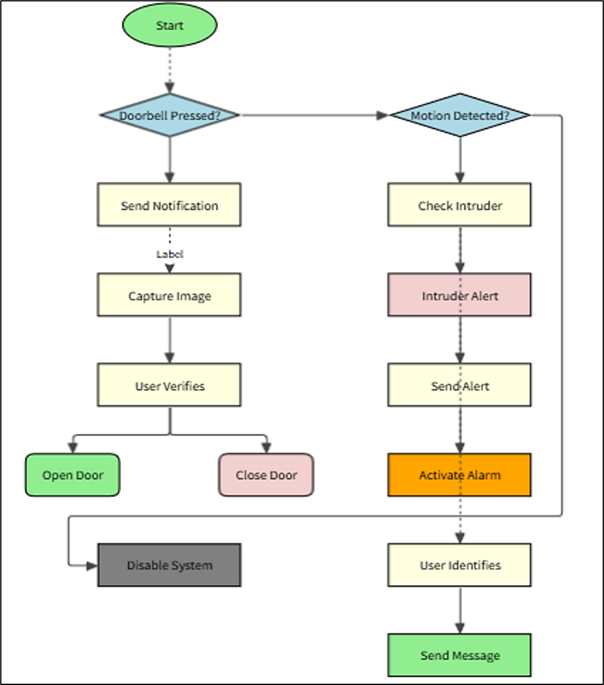
In the evolving landscape of home automation, security remains a top priority. This paper presents "Bell Buddy," a dual-mode smart doorbell system designed to enhance residential safety through real-time image processing and IoT integration. The system operates in two distinct modes: Doorbell Mode and Intruder Detection Mode. In Doorbell Mode, when the bell is pressed, a notification is instantly sent to the user`s mobile device, along with a captured image of the visitor for manual verification and remote access control. In Intruder Detection Mode, the system actively monitors for motion near the entrance and uses facial recognition algorithms to determine whether the detected individual is authorized or not. If an unknown face is identified, alerts are dispatched to both the user and predefined emergency contacts, while an audible alarm is triggered. The proposed system combines ESP32, Raspberry Pi, and cloud-based services for seamless real-time communication. The user interface is developed using React Native, while machine learning models trained using TensorFlow ensure accurate intruder detection. With end-to-end encryption and database integration, Bell Buddy offers an intelligent, efficient, and scalable solution for modern home security. The system has been evaluated on parameters such as recognition accuracy, notification speed, and reliability under varying environmental conditions.
References
[1] S. K. Sharma, L. Gupta, “A Novel Approach for Cloud Computing Environment,” International Journal of Computer Sciences and Engineering, Vol.4, Issue.12, pp.1-5, 2014.
[2] M. Khan, H. Anum, S. Batool, B. Bashir, “Smart Home with Wireless Smart Doorbell with Smart Response,” 2021 International Conference on Electrical, Computer, Communications and Mechatronics Engineering (ICECCME), Turkey, pp.120–124, 2021.
[3] S. Pawar, V. Kithani, S. Ahuja, S. Sahu, “Smart Home Security using IoT and Face Recognition,” 2018 International Conference on Computing Communication Control and Automation (ICCUBEA), Pune, India, pp.1–5, 2018.
[4] V. Bhanse, M. D. Jaybhaye, “Face Detection and Tracking using Image Processing on Raspberry Pi,” 2018 International Conference on Inventive Research in Computing Applications (ICIRCA), India, pp.542–545, 2018.
[5] D. R. Shenvi, K. Shet, “CNN Based Face Recognition for Home Security,” International Conference on AI and Smart Systems (ICAIS), India, pp.873–878, 2021.
[6] R. V. S. Lalitha, K. Kavitha, N. V. Krishna Rao, “Smart Surveillance with Smart Doorbell,” IEEE Access, Vol.8, pp.118309–118321, 2020.
[7] A. Mardin, T. Anwar, B. Anwer, “Image Compression using Discrete Transformation and Matrix Reduction,” International Journal of Scientific Research in Biological Sciences, Vol.5, No.1, pp.1–6, 2017.
[8] H. R. Singh, “Randomly Generated Algorithms and Dynamic Connections,” International Journal of Scientific Research in Biological Sciences, Vol.2, Issue.1, pp.231–238, 2014.
[9] C. Todeka, “Principle of Data Securing,” IJCSE Publication, India, pp.03–05, 2022.
[10] S. T. Tanwar, “Dive in Market of Crypto Currencies,” Journal of Computer Science and Engineering, Vol.13, Issue.1, pp.12–20, 2024.
Downloads
Published
How to Cite
Issue
Section
License

This work is licensed under a Creative Commons Attribution 4.0 International License.
Authors contributing to this journal agree to publish their articles under the Creative Commons Attribution 4.0 International License, allowing third parties to share their work (copy, distribute, transmit) and to adapt it, under the condition that the authors are given credit and that in the event of reuse or distribution, the terms of this license are made clear.



