
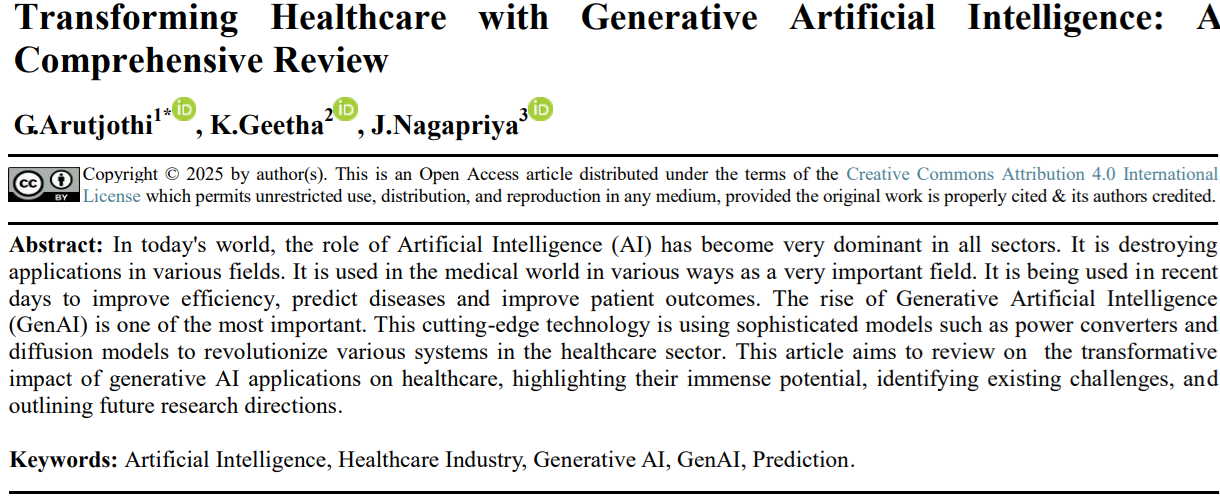
Transforming Healthcare with Generative Artificial Intelligence: A Comprehensive Review
DOI:
https://doi.org/10.26438/ijcse/v13i3.6569Keywords:
Artificial Intelligence,, Healthcare Industr, Generative AI, GenAI, PredictionAbstract
In today's world, the role of Artificial Intelligence (AI) has become very dominant in all sectors. It is destroying applications in various fields. It is used in the medical world in various ways as a very important field. It is being used in recent days to improve efficiency, predict diseases and improve patient outcomes. The rise of Generative Artificial Intelligence (GenAI) is one of the most important. This cutting-edge technology is using sophisticated models such as power converters and diffusion models to revolutionize various systems in the healthcare sector. This article aims to review on the transformative impact of generative AI applications on healthcare, highlighting their immense potential, identifying existing challenges, and outlining future research directions.
References
[1] Razzak, M. I., Naz, S., & Zaib, A., “ Deep learning for medical Image Processing: Overview, challenges and the future” , In Lecture notes in computational vision and biomechanics, pp.323–350, 2017.
[2] Chiu, T. K. F., “The impact of Generative AI (GenAI) on practices, policies and research direction in education: a case of ChatGPT and Midjourney”, Interactive Learning Environments, pp.1–17., 2023.
[3] Karbach, D. K., Haiduk, L., Bluher, G., Schreiter, M., & Lahmann, A., “The GenAI is out of the bottle: generative artificial intelligence from a business model innovation perspective”, Review of Managerial Science, Vol.18, Issue.4, pp.1189–1220, 2023.
[4] Kirova, V. D., Ku, C. S., Laracy, J. R., & Marlowe, T. J., “The Ethics of Artificial intelligence in the era of Generative AI”, Journal of Systemics, Cybernetics, and Informatics/Journal of Systemics Cybernetics and Informatics, Vol.21, Issue.4, pp.42–50, 2023.
[5] Xu, R., & Wang, Z., “Generative artificial intelligence in healthcare from the perspective of digital media: Applications, opportunities and challenges”, Helion, Vol.10, Issue.12, pp.e32364, 2024.
[6] Ferrara, E., “Fairness and Bias in Artificial intelligence: A brief survey of sources, impacts, and mitigation strategies” , Sci, Vol.6, Issue.1, pp.3, 2023.
[7] Kumar, D., Dhalwala, R., & Chaudhary, A., “Exploring the ethical implications of generative AI in healthcare”, In Advances in computational intelligence and robotics book series, pp.180–195, 2024.
[8] Small, W. R., Wiesenfeld, B., Bradfield-Harvey, B., Jonassen, Z., Mandal, S., Stevens, E. R., Major, V, “Large Language Model–Based responses to patients’ In-Basket messages”, JAMA Network Open, Vol.7, Issue.7, pp.e2422399, 2024.
[9] Agarwal, P., “Med Bot?: A GenAI based Chatbot for Healthcare”, Interantional Journal Of Scientific Research In Engineering And Management, Vol.8, Issue.6, pp.1–5, 2024.
[10] Seiferth, C., Vogel, L., Aas, B., Brandhorst, et al., “How to e-mental health: a guideline for researchers and practitioners using digital technology in the context of mental health”, Nature Mental Health, Vol.1, Issue.8, pp.542–554, 2023.
[11] David Ademola Oyemade, Diseimokumor Favour Seregbe, "A Machine Learning Model for the Classification of Human Emotions," International Journal of Computer Sciences and Engineering, Vol.12, Issue.4, pp.17-23, 2024.
[12] M.T. Stow, "Hybrid Deep Learning Approach for Predictive Maintenance of Industrial Machinery using Convolutional LSTM Networks," International Journal of Computer Sciences and Engineering, Vol.12, Issue.4, pp.1-11, 2024.
[13] Reddy S., “Generative AI in healthcare: an implementation science informed translational path on application, integration and governance”, Implement Sci. Mar 15; Vol.19, Issue.1, pp.27, 2024.
[14] Moulaei K, Yadegari A, Baharestani M, Farzanbakhsh S, Sabet B, Reza Afrash M, “ Generative artificial intelligence in healthcare: A scoping review on benefits, challenges and applications”, Int J Med Inform, 2024.
[15] Chen Y, Esmaeilzadeh P, “ Generative AI in Medical Practice: In-Depth Exploration of Privacy and Security Challenges”, J Med Internet Res. Mar 8; Vol.26, pp.e53008, 2024.
[16] Yim D, Khuntia J, Parameswaran V, Meyers A, “ Preliminary Evidence of the Use of Generative AI in Health Care Clinical Services: Systematic Narrative Review”, JMIR Med Inform. Mar 20;12:e52073, 2024.
[17] Zhang, P.; Kamel Boulos, M.N, “Generative AI in Medicine and Healthcare: Promises, Opportunities and Challenges”, Future Internet, 15, 286, 2023.
[18] Templin T, Perez MW, Sylvia S, Leek J, Sinnott-Armstrong N. “Addressing 6 challenges in generative AI for digital health: A scoping review”, PLOS Digit Health. May 23; Vol.3, Issue.5, pp.e0000503, 2024.
[19] Bhuyan SS, Sateesh V, Mukul N, Galvankar A, Mahmood A, Nauman M, Rai A, Bordoloi K, Basu U, Samuel J, “Generative Artificial Intelligence Use in Healthcare: Opportunities for Clinical Excellence and Administrative Efficiency”, J Med Syst. Jan 16; Vol.49, Issue.1, pp.10, 2025.
Downloads
Published
How to Cite
Issue
Section
License

This work is licensed under a Creative Commons Attribution 4.0 International License.
Authors contributing to this journal agree to publish their articles under the Creative Commons Attribution 4.0 International License, allowing third parties to share their work (copy, distribute, transmit) and to adapt it, under the condition that the authors are given credit and that in the event of reuse or distribution, the terms of this license are made clear.



