
A Comprehensive Process Guide to ERP Implementation and Its Challenges
DOI:
https://doi.org/10.26438/ijcse/v13i2.7885Keywords:
Enterprise Resource Planning, Business Process Integration, Data MigrationAbstract
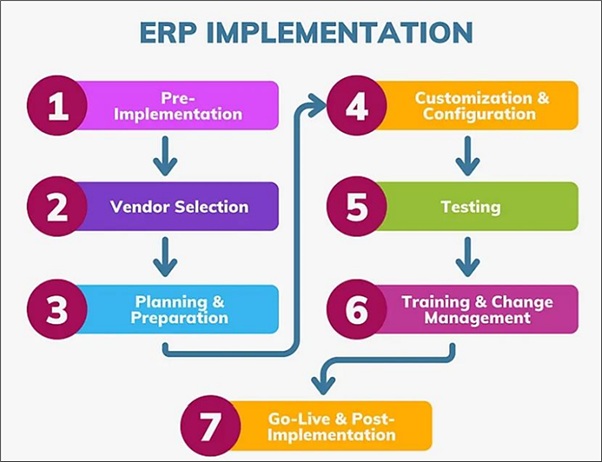
Cloud Enterprise Resource Planning (ERP) systems are crucial in streamlining business processes, integrating various functions, and improving organizational efficiency. This paper presents a comprehensive process guide for ERP implementation, detailing each phase from planning and selection to deployment and post-implementation support. Additionally, it addresses the common challenges organizations face during ERP implementation, including data migration, user adoption, system customization, and change management issues. By exploring these challenges and providing actionable insights, this paper aims to guide businesses with the knowledge to navigate the complexities of ERP implementation successfully. Through a combination of practical steps and real-world examples, this guide is a valuable resource for organizations seeking to optimize their ERP systems and ensure long-term success.
References
[1] C.V. Monroy, G.C.A. Ariasa, and Y.N. Guerrero, “The new cloud computing paradigm: The way to IT seen as a utility,” Latin Amer. Caribbean J. Eng. Educ., Vol.6, Issue.2, pp.24–31, 2012.
[2] L.M. Vaquero, “EduCloud: PaaS versus IaaS cloud usage for an advanced computer science course,” IEEE Trans. Educ., Nov., Vol.54, Issue.4, pp.590–598, 2011.
[3] A.O. Akande and J.P. Van Belle, “Cloud computing in higher education: Snapshot of software as a service,” in Proc. IEEE 6th Int. Conf. Adapt. Sci. Technol, Oct., pp.1–5, 2014.
[4] T. Rodmunkong, P. Wannapiroon, and P. Nilsooka, “The architecture of information management system through cloud computing according to Thai qualifications framework for higher education,” in Proc. IEEE Int. Conf. Teach., Assessment, Learn. Eng. (TALE), Dec., pp.181–188, 2015.
[5] F. Tao, J. Panneerselvam, T. Holding, and L. Liua, “A cloud-based sustainable business model for effective ICT provision in higher education,” in Proc. 9th IEEE Int. Symp. Service Oriented Syst. Eng. (SOSE), Mar., pp.222–228, 2015.
[6] M.A.H. Masud and X. Huang, “ESaaS: A new software paradigm for supporting higher education in a cloud environment,” in Proc. IEEE 17th Int. Conf. Comput. Supported Cooperative Work Design (CSCWD), Jun., pp.196–201, 2013.
[7] C.S. Chang, T.S. Chen, and H.L. Hsu, “The implications of learning cloud for education: From the perspectives of learners,” in Proc. IEEE 7th Int. Conf. Wireless, Mobile Ubiquitous Technol. Educ., Mar., pp.157–161, 2012.
[8] P. Veni and R. Masillamania, “Resource sharing cloud for university clusters,” in Proc. IEEE/ACM Int. Conf. Cyber, Green Comput. Commun. Phys. Social Comput. (CPSCom), Dec., pp.873–878, 2010.
[9] M. Mohan and R. Alvarez-Horinea, “A successful graduate cloud computing class with hands-on labs,” in Proc. IEEE Frontiers Educ. Conf. (FIE), Oct., pp.1156–1162, 2013.
[10] A.C. Caminero, S. Ros, R. Hernández, A. Robles-Gómez, L. Tobarra, and P.J.T. Granjo, “Virtual remote laboratories management system (TUTORES): Using cloud computing to acquire university practical skills,” IEEE Trans. Learn—Technol., Apr., Vol.9, Issue.2, pp.133–145, 2016.
[11] G. Magyar, T. Câdrik, M. Virciková, and P. Sincâk, “Towards an adaptive cloud-based platform for robotic assistants in education,” in Proc. IEEE 12th Int. Symp. Appl. Mach. Intell. Inform. (SAMI), Jan., pp.285–289, 2014.
[12] P. Chillakanti and C. Gattaza, “A SaaS framework for transdisciplinary collaboration,” in Proc. IEEE 10th Int. Conf. Semantic Comput. (ICSC), Feb., pp.437–442, 2016.
[13] L. Zhang and Q. Peng, “Research of mobile learning system based on the cloud environment,” in Proc. IEEE Workshop Electron., Comput. Appl., May, pp.653–656, 2014.
[14] P. Li, “Portable lab modules on cloud computing,” in Proc. IEEE Frontiers Educ. Conf. (FIE), Oct., pp.430–431, 2013.
[15] A.C. Caminero et al., “Obtaining university practical competencies in engineering using virtualization and cloud computing technologies,” in Proc. IEEE Int. Conf. Teach., Assessment Learn. Eng. (TALE), Aug., pp.301–306, 2013.
[16] A.C. Caminero et al., “Harnessing cloud for e-learning: New directions followed by UNED,” in Proc. IEEE Global Eng. Educ. Conf. (EDUCON), pp.412–416, 2011.
[17] M. Wannous, M. Mahfuri, H. Nakano, and T. Nagai, “Facilitating access to course contents during war situations with M-learning and cloud computing technologies,” in Proc. IEEE Int. Conf. Teach., Assessment Learn. Eng. (TALE), pp.93–96, 2014.
[18] S. Ouf, M. Nasr, and Y. Helmy, “An enhanced e-learning ecosystem based on an integration between cloud computing and Web 2.0,” in Proc. 10th IEEE Int. Symp. Signal Process. Inf. Technol., pp.48–55, 2010.
[19] Uma Maheswara Rao Ulisi, “Challenges in Supporting API Features within the Software as a Service (SaaS) Cloud Model,” OSR J. Comput. Eng., Vol.27, Issue.1, pp.10–14, 2025.
[20] J.M. Long, “Cloud-based teachings in an engineering-physics course,” in Proc. IEEE Frontiers Educ. Conf. (FIE), pp.1–8, 2015.
[21] G.L. Gomes and A. Costa, “Cloud-based development framework using IOPT Petri nets for embedded systems teaching,” in Proc. IEEE 23rd Int. Symp. Ind. Electron. (ISIE), pp.2202–2206, 2014.
[22] Uma Maheswara Rao Ulisi, “Think and Thin: Optimizing Ledgers in the Cloud,” IRJMETS, Vol.7, Issue.1, pp.70100086470, 2025.
[23] L. Gomes and A. Costa, “Cloud-based development framework using IOPT Petri nets for embedded systems teaching,” in Proc. IEEE 23rd Int. Symp. Ind. Electron. (ISIE), pp.2202–2206, 2014.
[24] Uma Maheswara Rao Ulisi, “Oracle Cloud Financials and Artificial Intelligence: Transforming Financial Management through Automation and Data-Driven Insights,” Proc. Int. J. Eng. Sci. Math., Vol.13, Issue.12, pp.32–43, 2024.
[25] Uma Maheswara Rao Ulisi, “ERP Financial Books Soft Close Approach to Financial Control and Operational Efficiency,” IRJMETS, Certificate, Vol.7, Issue.1, 2025.
Downloads
Published
How to Cite
Issue
Section
License

This work is licensed under a Creative Commons Attribution 4.0 International License.
Authors contributing to this journal agree to publish their articles under the Creative Commons Attribution 4.0 International License, allowing third parties to share their work (copy, distribute, transmit) and to adapt it, under the condition that the authors are given credit and that in the event of reuse or distribution, the terms of this license are made clear.



