
Enhancing Efficiency and Scalability: DevOps Implementation for Educational Chat Systems
DOI:
https://doi.org/10.26438/ijcse/v12i3.1924Keywords:
Academic results, AWS Cloud,, Chatbot, Continuous Integration,, DevOps, Jenkins, TelegramAbstract
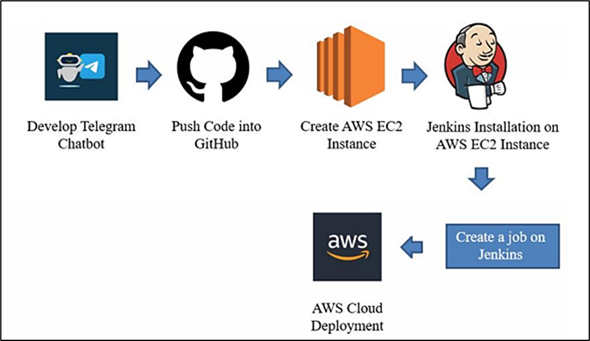
This study presents a thorough technique for the implementation of a Telegram chatbot created especially for educational institutions to expedite the tracking of attendance and academic results. The chatbot is constructed using Python`s Telebot library and DevOps concepts. It is then carefully deployed on an AWS EC2 instance to ensure smooth interaction with a variety of educational systems and to meet the specific needs of different academic institutions. Jenkins makes continuous integration easier by automating the deployment and build processes, which increases scalability and efficiency. The chatbot`s customization possibilities enable customized integration with current educational infrastructures, guaranteeing flexibility and adaptability. Additionally, the project`s strong design allows for future growth and the addition of sophisticated features like learning management system integration. The chatbot seeks to maintain ongoing relevance and efficacy in promoting student participation and optimizing academic administration procedures by continuing to be flexible in response to new technological developments. This study demonstrates how chatbot technology may revolutionize educational services and administration, supporting the further development of academic institutions in the digital era. This study highlights the revolutionary potential of chatbot technology in transforming student services and academic administration by connecting technological innovation with educational demands.
References
[1] Eleni Adamopoulou, Lefteris Moussiades “Machine Learning With Applications, Chatbots: History, Technology, And Applications”, Science Direct, Vol.2, 2020.
[2] Aishwarya Gupta, Divya Hathwar, Anupama Vijayakumar “Introduction To AI Chatbots”, International Journal of Engineering Research & Technology (IJERT), Vol.9, Issue.7, pp.255-258, 2020.
[3] Chinedu Wilfred Okonkwo, Abejide Ade-Ibijola “Computers and Education: Artificial Intelligence, Chatbots applications in education: A systematic review”, Science Direct, Vol.2, 2021.
[4] Aadil Hasan “A Review Paper on DevOps Methodology”, International Journal of Creative Research Thoughts (IJCRT), Vol.8, Issue.6, pp.2583-2589, 2020.
[5] Dhaya Sindhu Battin “Devops, A New Approach To Cloud Development & Testing”, Journal of Emerging Technologies and Innovative Research (JETIR), Vol.7, Issue.8, pp.982-985, 2020.
[6] Arpita S.K, Amrathesh, Dr. Govinda Raju M “A review on Continuous Integration, Delivery and Deployment using Jenkins”, Journal of University of Shanghai for Science and Technology, Vol.23, Issue.6, pp.919-922, 2021.
[7] Pooja D Pandit “A Case Study of Amazon Web Services”, ResearchGate, 2021.
[8] Rahul Saini, Rachna Behl “An Introduction to AWS – EC2 (Elastic Compute Cloud)”, International Conference on Research in Management & Technovation, Vol.24, pp.99-102, 2020.
[9] Eleni Rütz, Martin, Fachhochschule Wedel, Wedel “DEVOPS: A SYSTEMATIC LITERATURE REVIEW”, ResearchGate, 2019.
[10] Laiby Thomas, Subramanya Bhat “A Comprehensive Overview of Telegram Services - A Case Study”, International Journal of Case Studies in Business, IT, and Education (IJCSBE), Vol.6, No.1, pp.288-301, 2022.
[11] Pallavi Deshwal, Poonam Ghuli “DevOps: Concept, Technology and Tools”, International Journal of Computer Sciences and Engineering, Vol.8, Issue.6, pp.73-78, 2020.
[12] Mahadevi S. Namose, Shobha D. Patil “Standard DevOps Pipeline”, International Journal of Computer Sciences and Engineering, Vol.7, Issue.3, pp.641-646, 2019.
Downloads
Published
How to Cite
Issue
Section
License

This work is licensed under a Creative Commons Attribution 4.0 International License.
Authors contributing to this journal agree to publish their articles under the Creative Commons Attribution 4.0 International License, allowing third parties to share their work (copy, distribute, transmit) and to adapt it, under the condition that the authors are given credit and that in the event of reuse or distribution, the terms of this license are made clear.



