
Autism Spectrum Disorder Detection from Parents Dialogues Using Multinomial Naïve Bayes and XGBoost Models
DOI:
https://doi.org/10.26438/ijcse/v12i2.1829Keywords:
Autism Spectrum Disorder, Machine Learning, ASD Detection, ML-based Framework, Traditional Machine Learning, Multinomial Naïve Bayes, XGBoostAbstract
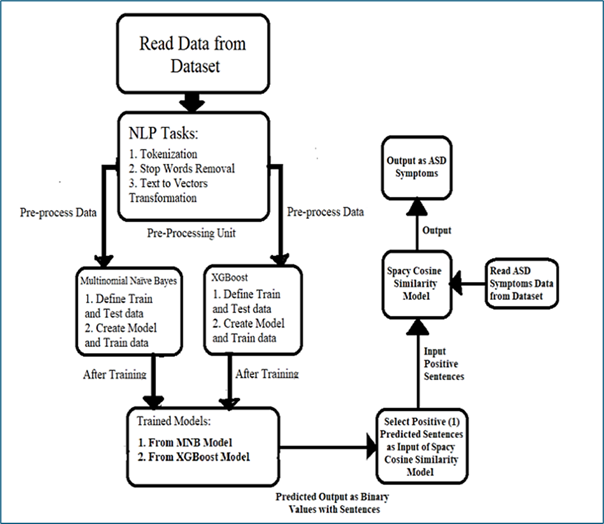
To indicate the proper development of a child, there are certain baseline milestones. If a child is not reaching the milestones at the expected rate, it can indicate that there is an issue that needs to be addressed. By early intervention, the development of the child can be improved and the long-term impact of the developmental delays may be reduced. One such constraint of child development is Autism spectrum disorder. The ASD-affected children exhibit difficulties in communication, socialization and challenges in physical, social, and emotional development. This neurodevelopmental disorganization may exhibit an extensive range of effects and symptoms including challenges in communication, social interactions, and physical, social, and emotional behaviours. To identify ASD symptoms in a child, the range of ASD symptoms must be available as datasets to the researchers. The difficult phenomenon is that parents are not able to identify or detect early-age indications of ASD in their children. This proposed research work aims to detect the symptoms of ASD from parents’ dialogues. The dataset has collected data from many autism groups from social media and organizations for special children. To understand the sentiment of parents’ dialog there are two important and popular machine learning models, the Multinomial Naïve Bayes and the XGBoost. Naïve Bayes is based on a probabilistic machine learning model and XGBoost is an ensemble-oriented model. If new data comes from a new parent, the sentiment of that data is also predicted by these models. By using these two models, sentiment analysis can help to identify ASD symptoms. Based on the prepared data, the accuracy of these two models is 70% and 70% respectively.
References
[1] A. Tewari, S. D. Khanna, R. Bathija, R. Daryani, A. Reejhsinghani, “ASD (Autism Spectrum Disorder): Early Detection Intervention using Machine Learning”, International Journal of Innovative Science and Research Technology, Vol.5, No.1, pp.7-13, 2020.
[2] P. Mesa-Gresa, H. Gil-G´omez, L. Quilis, G. Gomez, “Effectiveness of virtual reality for children and adolescents with autism spectrum disorder: an evidence-based systematic review”, Sensors, Vol.18, No.8, Art. No.2486, 2018.
[3] S. E. Bryson, L. Zwaigenbaum, W. Roberts, “The early detection of autism in clinical practice”, Pediatrics & Child Health, Vol.9, No.4, pp.219–221, 2004.
[4] S. Islam, T. Akter, S. Zakir, S. Sabreen, M. I. Hossain, “Autism Spectrum Disorder Detection in Toddlers for Early Diagnosis Using Machine Learning”, IEEE Asia-Pacific Conference on Computer Science and Data Engineering (CSDE), pp.1-6, 2020.
[5] R. Murugan, L. Senbagamalar, “Prediction of Autism Spectrum Disorder using Machine Learning”, Journal of Emerging Technologies and Innovative Research (JETIR), Vol.9, No.2, pp.c950-c959, 2022.
[6] D. Bone, M. S. Goodwin, M. P. Black, C. C. Lee, K. Audhkhasi, and S. Narayanan, “Applying Machine Learning to Facilitate Autism Diagnostics: Pitfalls and promises”, Journal of Autism and Developmental Disorders, pp.1-48, 2014.
[7] A. Saranya, R. Anandan, “Autism Spectrum Prognosis using Worm Optimized Extreme Learning Machine (WOEM) Technique”, International Conference on Advance Computing and Innovative Technologies in Engineering (ICACITE), pp.636–641, 2021.
[8] N. Zaman, J. Ferdus, A. Sattar, “Autism Spectrum Disorder Detection Using Machine Learning Approach”, 12th International Conference on Computing Communication and Networking Technologies (ICCCNT), Kharagpur, India, pp.1-6, 2021.
[9] V. Kavitha, R. Siva, “Classification of Toddler, Child, Adolescent and Adult for Autism Spectrum Disorder Using Machine Learning Algorithm”, 9th International Conference on Advanced Computing and Communication Systems (ICACCS), Coimbatore, India, pp.2444-2449, 2023.
[10] S. Islam, T. Akter, S. Zakir, S. Sabreen, M. I. Hossain, “Autism Spectrum Disorder Detection in Toddlers for Early Diagnosis Using Machine Learning”, IEEE Asia-Pacific Conference on Computer Science and Data Engineering (CSDE), Gold Coast, Australia, pp.1-6, 2020.
[11] J.R. Adams, A. C. Salem, H. MacFarlane, R. Ingham, S. D. Bedrick, E. Fombonne, J. K. Dolata, A.P. Hill, and J. V. Santen, “A Pseudo-Value Approach to Analyze the Semantic Similarity of the Speech of Children With and Without Autism Spectrum Disorder”, Front. Psychol., pp.1-10, 2021.
[12] K. E. Prescott, J. M. Scott, T. Reuter, J. Edwards, J. Saffran, S. E. Weismer, “Predictive language processing in young autistic children”, Autism Research, pp.1-12, 2022.
[13] C. Orasan, R. Evans, R. Mitkov, “Intelligent text processing to help readers with autism”, Intelligent Natural Language Processing: Trends and Applications, pp.713-740, 2017.
[14] T. Zhang, A. M. Schoene, S. Ji, S. Ananiadou, “Natural language processing applied to mental illness detection: a narrative review”, NPJ Digital Medicine, pp.1-13, 2022.
[15] G. Anurekha, P. Geetha, “Performance Analysis of Supervised Approaches for Autism Spectrum Disorder Detection”, International Journal of Trend in Research and Development, pp.1-3, 2017.
[16] N. Ajaypradeep and R. Sasikala, “Child Behavioral Analysis: Machine Learning based Investigation for Autism Screening and Early Diagnosis”, International Journal of Early Childhood Special Education, Vol.13, No.2, pp.1199-1208, 2021.
[17] I. A. Ahmed, E. M. Senan, T. H. Rassem, M. Ali, H. S. A. Shatnawi, S. M. Alwazer, and M. Alshahrani, “Eye Tracking-Based Diagnosis and Early Detection of Autism Spectrum Disorder Using Machine Learning and Deep Learning Techniques”, MDPI Electronics, Vol.11, pp.1-27, 2022.
[18] A. Yasumura, M. Omori, A. Fukuda, J. Takahashi, Y. Yasumura, E. Nakagawa, T. Koike, Y. Yamashita, T. Miyajima, T. Koeda, M. Aihara, H. Tachimori, M. Inagaki, “Applied Machine Learning Method to Predict Children With ADHD Using Prefrontal Cortex Activity: A Multicenter Study in Japan”, Journal of Attention Disorders, pp.1-9, 2017.
[19] A. Vahid, A. Bluschke, V. Roessner, S. Stober, and C. Beste, “Deep Learning Based on Event-Related EEG Differentiates Children with ADHD from Healthy Controls”, Journal of Clinical Medicine, pp.1-15, 2019.
[20] A. Tenev, S. M. Simoska, L. Kocarev, J. P. Jordanov, A. Müller, G. Candrian, “Machine learning approach for classification of ADHD adults”, International Journal of Psychophysiology, pp.1-5, 2013.
[21] S. P. Barus, “Implementation of Naïve Bayes Classifier-based Machine Learning to Predict and Classify New Students at Matana University”, International Conference on Science Education and Technology (ICOSETH), pp.1-7, 2020.
Downloads
Published
How to Cite
Issue
Section
License

This work is licensed under a Creative Commons Attribution 4.0 International License.
Authors contributing to this journal agree to publish their articles under the Creative Commons Attribution 4.0 International License, allowing third parties to share their work (copy, distribute, transmit) and to adapt it, under the condition that the authors are given credit and that in the event of reuse or distribution, the terms of this license are made clear.



