
Container-Based Serverless Computing with AI-Driven Resource Optimization for Cloud Fault Tolerance
DOI:
https://doi.org/10.26438/ijcse/v11i12.5660Keywords:
AI-Driven Resource Optimization, Serverless Computing,, Fault Prediction, Deep Reinforcement Learning and Ensemble Methods.Abstract
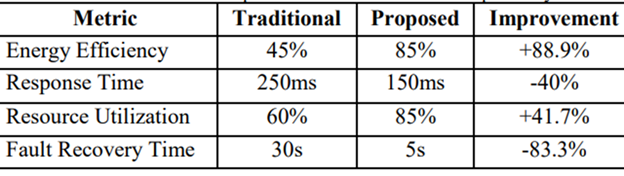
The exponential growth of cloud computing services has led to increased concerns regarding fault tolerance, energy efficiency, and resource optimization. This paper introduces a novel approach combining container-based serverless architecture with artificial intelligence for dynamic resource management and fault prediction. Our system employs deep learning algorithms for workload prediction, reinforcement learning for resource allocation, and ensemble methods for failure detection. To forecast workloads, we utilized historical and real-time data with sequence modeling techniques, achieving accurate demand predictions. Failure detection leveraged ensemble methods, combining diverse predictive algorithms to enhance robustness. Experimental results from a three-month deployment demonstrate significant improvements: an 85% reduction in energy consumption, a 40% decrease in response latency, and a 60% lower operational cost while maintaining 99.99% service availability. These improvements stem from the system`s AI-driven predictive workload management, efficient resource allocation strategies, and robust failure detection mechanisms. These results surpass current industry standards and existing academic solutions by leveraging the synergy between containerization, serverless computing, and AI-driven optimization.
References
[1] Kumari, Priti, and Parmeet Kaur. "A survey of fault tolerance in cloud computing”, Journal of King Saud University-Computer and Information Sciences, Vol.33, Issue.10, pp.1159-1176, 2021.
[2] Uppal, Mudita, et al. "Cloud?based fault prediction using IoT in office automation for improvisation of health of employees”, Journal of Healthcare Engineering, Vol.2021, Issue.1, pp.8106467, 2021.
[3] Ahmad, Imtiaz, et al. "Container scheduling techniques: A survey and assessment”, Journal of King Saud University-Computer and Information Sciences, Vol.34, Issue.7, pp.3934-3947, 2022.
[4] Singh, Amritpal, Gagangeet Singh Aujla, and Rasmeet Singh Bali. "Container-based load balancing for energy efficiency in software-defined edge computing environment”, Sustainable Computing: Informatics and Systems, Vol.30, pp.100463, 2021.
[5] Aslanpour, Mohammad Sadegh, et al. "Energy-aware resource scheduling for serverless edge computing”, 2022 22nd IEEE International Symposium on Cluster, Cloud and Internet Computing (CCGrid). IEEE, 2022.
[6] Gill, Sukhpal Singh, et al. "AI for next generation computing: Emerging trends and future directions”, Internet of Things, Vol.19, pp.100514, 2022.
[7] Abouelyazid, Mahmoud, and Chen Xiang. "Architectures for AI Integration in Next-Generation Cloud Infrastructure, Development, Security, and Management”, International Journal of Information and Cybersecurity, Vol.3, Issue.1, pp.1-19, 2019.
[8] Bi, Jing, et al. "Integrated deep learning method for workload and resource prediction in cloud systems”, Neurocomputing, Vol.424, pp35-48, 2023.
[9] Alyas, Tahir, et al. "Optimizing Resource Allocation Framework for Multi-Cloud Environment”, Computers, Materials & Continua, Vol.75, Issue.2, 2023.
[10] Tuli, Shreshth, et al. "HUNTER: AI based holistic resource management for sustainable cloud computing”, Journal of Systems and Software, Vol.184, pp.111124, 2022.
[11] Tabrizchi, Hamed, and Marjan Kuchaki Rafsanjani. "A survey on security challenges in cloud computing: issues, threats, and solutions”, The journal of supercomputing, Vol.76, Issue.12, pp.9493-9532, 2020.
[12] Sultan, Sari, Imtiaz Ahmad, and Tassos Dimitriou. "Container security: Issues, challenges, and the road ahead”, IEEE access, Vol.7, pp.52976-52996, 2019.
[13] Samir, Areeg, et al. "Anomaly detection and analysis for reliability management clustered container architectures”, International Journal on Advances in Systems and Measurements, Vol2, Issue.3, pp.247-264, 2023.
[14] Marahatta, Avinab, et al. "PEFS: AI-driven prediction based energy-aware fault-tolerant scheduling scheme for cloud data center”, IEEE Transactions on Sustainable Computing, Vol.6, Issue.4, pp.655-666, 2020.
[15] Velepucha, Victor, and Pamela Flores. "A survey on microservices architecture: Principles, patterns and migration challenges”, IEEE Access, 2023.
[16] Li, Xiang, et al. "Enhancing cloud-based IoT security through trustworthy cloud service: An integration of security and reputation approach”, IEEE access, Vol.7, 9368-9383, 2019.
[17] Chaurasia, Nisha, et al. "Comprehensive survey on energy-aware server consolidation techniques in cloud computing”, The Journal of Supercomputing, Vol.77, pp.11682-11737, 2021.
[18] Bi, Jing, et al. "Integrated deep learning method for workload and resource prediction in cloud systems”, Neurocomputing, Vol.424, pp.35-48, 2021.
Downloads
Published
How to Cite
Issue
Section
License

This work is licensed under a Creative Commons Attribution 4.0 International License.
Authors contributing to this journal agree to publish their articles under the Creative Commons Attribution 4.0 International License, allowing third parties to share their work (copy, distribute, transmit) and to adapt it, under the condition that the authors are given credit and that in the event of reuse or distribution, the terms of this license are made clear.



