
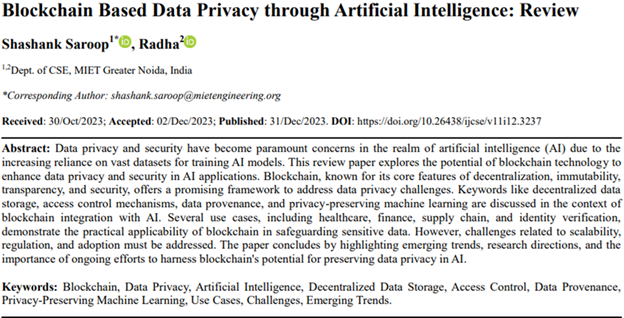
Blockchain Based Data Privacy through Artificial Intelligence: Review
DOI:
https://doi.org/10.26438/ijcse/v11i12.3237Keywords:
Blockchain,, Data Privacy, Artificial Intelligence, Decentralized Data StorageAbstract
Data privacy and security have become paramount concerns in the realm of artificial intelligence (AI) due to the increasing reliance on vast datasets for training AI models. This review paper explores the potential of blockchain technology to enhance data privacy and security in AI applications. Blockchain, known for its core features of decentralization, immutability, transparency, and security, offers a promising framework to address data privacy challenges. Keywords like decentralized data storage, access control mechanisms, data provenance, and privacy-preserving machine learning are discussed in the context of blockchain integration with AI. Several use cases, including healthcare, finance, supply chain, and identity verification, demonstrate the practical applicability of blockchain in safeguarding sensitive data. However, challenges related to scalability, regulation, and adoption must be addressed. The paper concludes by highlighting emerging trends, research directions, and the importance of ongoing efforts to harness blockchain`s potential for preserving data privacy in AI.
References
[1] Sweeney, L. K-anonymity: “A model for protecting privacy. International Journal of Uncertainty, Fuzziness and Knowledge-Based Systems” Vol.10, Issue.5, pp.557-570, 2002.
[2] Dwork, C, McSherry, F, Nissim, K, & Smith, A. “Calibrating noise to sensitivity in private data analysis”. In Proceedings of the Third Conference on Theory of Cryptography (TCC`06), 2002.
[3] Nakamoto, S. “Bitcoin: A Peer-to-Peer Electronic Cash System” https://bitcoin.org/bitcoin.pdf, 2008.
[4] Lauter, K., Naehrig, M., & Vaikuntanathan, V. “Can homomorphic encryption be practical” In Proceedings of the 3rd ACM workshop on Cloud computing security workshop (CCSW`11), 2008.
[5] Back, A, Corallo, M., Dashjr, L., Friedenbach, M., Maxwell, G., Miller, A., ... & Wuille, P.” Enabling Blockchain Innovations with Pegged Sidechains”, 2014.
[6] Ben-Sasson, E., Chiesa, A., Garman, C., Green, M., Miers, I., Tromer, E., ... & Virza, M. (2014). Zero Cash: Decentralized anonymous payments from Bitcoin in IEEE Symposium on Security and Privacy, 2014.
[7] LeCun, Y. Bengio, Y. & Hinton, G. “Deep learning. Nature”, 521(7553), pp.436-444, 2014.
[8] Swan, M. “Blockchain: Blueprint for a New Economy” O`Reilly Media, 2015.
[9] Bonneau, J., Miller, A., Clark, J., Narayanan, A., Kroll, J. A., & Felten, E. W. “Research perspectives and challenges for bitcoin and cryptocurrencies” in Proceedings of the IEEE Symposium on Security and Privacy. 2015.
[10] Intel. (2016). Intel Software Guard Extensions (Intel SGX) for Fun and Profit. 2016.
[11] O`Neil, C. “Weapons of Math Destruction: How Big Data Increases Inequality and Threatens Democracy Crown”, 2016.
[12] Poon, J., & Dryja, T “The Bitcoin Lightning Network: Scalable Off-Chain Instant Payments” https://lightning.network/lightning-network-paper.pdf . 2016.
[13] Mougayar, W. “The Business Blockchain: Promise, Practice, and Application of the Next Internet Technology”, Wiley. 2016
[14] Tapscott, D., & Tapscott, A. “Blockchain Revolution: How the Technology Behind Bitcoin is Changing Money, Business, and the World. Penguin” 2016.
[15] Kosba, A., Miller, A., Shi, E., Wen, Z., & Papamanthou, C. Hawk “The blockchain model of cryptography and privacy-preserving smart contracts” in Proceedings of the ACM SIGSAC Conference on Computer and Communications Security (CCS`16), 2016
[16] Crosby, M., Pattanayak, P., Verma, S., & Kalyanaraman, V. “Blockchain technology: Beyond bitcoin Applied Innovation”, 6-10, pp.71-81, 2016.
[17] Voigt. P, Von dem Bussche, A. “The EU General Data Protection Regulation” (GDPR): A Practical Guide. Springer. 2017.
[18] B., Patel, S., ... & Viswanathan, V. “Practical secure aggregation for privacy-preserving machine learning”. In Proceedings of the 2017 ACM SIGSAC Conference on Computer and Communications Security (CCS`17), 2017.
[19] McMahan, H. B. Moore, E. Ramage, D. Hampson, S. & Arcas, “Communication-efficient learning of deep networks from decentralized data”, in Proceedings of the 20th International Conference on Artificial Intelligence and Statistics (AISTATS), 2018.
[20] Gupta, A. Capretz, L. F. & Ahmed, F. “Towards understanding blockchain roles in improving the Internet of Things”. in IEEE 5th World Forum on Internet of Things (WF-IoT) (pp. 127-132). 2018.
[21] Mengelkamp. E, Notheisen, B, Bräuer, S, & Flath, C. M. “A blockchain-based smart grid: towards sustainable local energy markets” in Computer Science-Research and Development, Vol.33, Issue.1-2, pp.207-214, 2018.
[22] Al-Bassam. M, Sonnino. A, Bano. S, Hrycyszyn, D., Danezis, G., & Papamanthou, C. (2018). Chainspace: A Sharded Smart Contracts Platform. In Proceedings of the ACM SIGSAC Conference on Computer and Communications Security (CCS`18). 2018.
[23] Hernandez, C. (2019). 6 “Biggest Data Breaches in History Forbes. www.forbes.com/sites/christopherhelman2019/01/19/6-of-the biggest-data-breaches-in-history. 2019.
[24] Kairouz. P, McMaha. B, Avent. B, Bellet. A. Bennis. M, Bhagoji. Zhang, S. “Advances and open problems in federated learning”. preprint arXiv:1912.04, 2019.
Downloads
Published
How to Cite
Issue
Section
License

This work is licensed under a Creative Commons Attribution 4.0 International License.
Authors contributing to this journal agree to publish their articles under the Creative Commons Attribution 4.0 International License, allowing third parties to share their work (copy, distribute, transmit) and to adapt it, under the condition that the authors are given credit and that in the event of reuse or distribution, the terms of this license are made clear.



