
Fake News Detection Using Machine Learning Algorithm Logistic Regression
DOI:
https://doi.org/10.26438/ijcse/v11i11.1316Keywords:
Fake news, Natural Language processing, Logistic Regression, Machine Learning, Term Frequency Inverse Document Frequency, Text Processing+Abstract
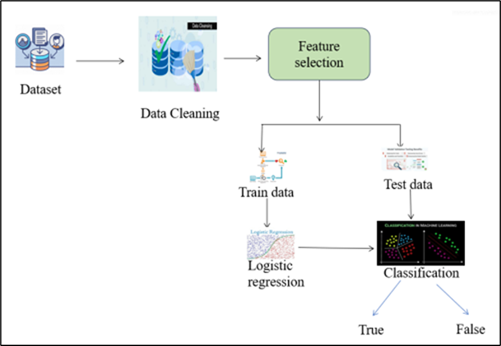
Machine learning is field of Artificial Intelligence that focuses on the development of algorithms and statistical methods. Fake news has caused a lot of issues for our society. Many researchers are trying to determine what fake news is. It is challenging to recognize ambiguous fake news, can only be found after determining meaning and recent pertinent facts. For news, everyone uses a variety of online sources. News quickly disseminated among millions of users in a very short period of time to the increase in the use of social media platforms like Facebook, Twitter, etc. We will enable the user to categorize news as either genuine or real. The logistic regression approach will be used to identify false news. Natural Language processing techniques like Term Frequency Inverse Document Frequency (TF-IDF), text processing etc. In our experiment, we`ll demonstrate how our method boosts bogus news` overall performance. We are providing URL search whether the given URL is fake or not.
References
[1] Xinyi Zhou, Reza Zafarani "A Survey of Fake News: Fundamental Theories, Detection Methods and Opportunities”, ACM journals, Vol.53, Issue.5, pp.1-40, 2020.
[2] Aswini thota, Priyanka tilak, simrat, Nibrat, "Fake news detection: A deep learning approach", SMU Data Science Review, Vol.1, No.3, Article 10, 2018.
[3] Z Khanam,B N Alwasel,H Sirafi,M Rashid, "Fake news detetction using machine learning approaches", IOP science, Vol.1099, 2020. DOI:10.1088/1757-889X/1099/1/012040
[4] Xinyi zhou, Reza zafarani, "Network-based Fake news Detection:A Pattern driven Approach", ACM journals, Vol.21, Issue.2, pp.48-60, 2019.
[5] Z Khanam, B.N. Alwasel, Sirafi, M Rashid, "Fake news detetction using machine learning approaches", IOP science, Vol.1099, 2020. DOI:10.1088/1757-889X/1099/1/012040
[6] Iftikhar Ahmad, Muhammad Yousaf, Suhail Yousaf, Muhammad Ovais Ahmad," Fake news Detection using machine learning ensemble methods, Hindawi, 2020.
[7] M. M. V. Y. a. A. Granik, “Determining Fake Statements Made by Public Figures by Means of Artificial Intelligence” International Scientific and Technical Conference on Computer Sciences and Information Technologies (CSIT), Vol.1, pp.424-427, 2018.
[8] V.L.Rubin and T.Lukoianova “Truth anddeception at the rhetorical structure level”. Journal of the Association for Information Science and Technology, Vol.66, Issue.5, pp.905-917, 2015.
[9] Conroy,J. Niall,L. Victoria L. Rubin,Y. Chen, “Automatic deception detection: Methods for finding fake news,” In the Proceedings of the 2015 Association for Information Science and Technology, Vol.52, No.1, pp.1-4, 2015.
Downloads
Published
How to Cite
Issue
Section
License

This work is licensed under a Creative Commons Attribution 4.0 International License.
Authors contributing to this journal agree to publish their articles under the Creative Commons Attribution 4.0 International License, allowing third parties to share their work (copy, distribute, transmit) and to adapt it, under the condition that the authors are given credit and that in the event of reuse or distribution, the terms of this license are made clear.



