
Efficient Resource Utilization with Auto Tagging Using Amazon`s Cloud Trail Services
DOI:
https://doi.org/10.26438/ijcse/v11i9.1116Keywords:
utomated Tagging, CloudTrail, Resource Management, Amazon Web Services, Resource Identification, Cost Attribution, Resource InventoryAbstract
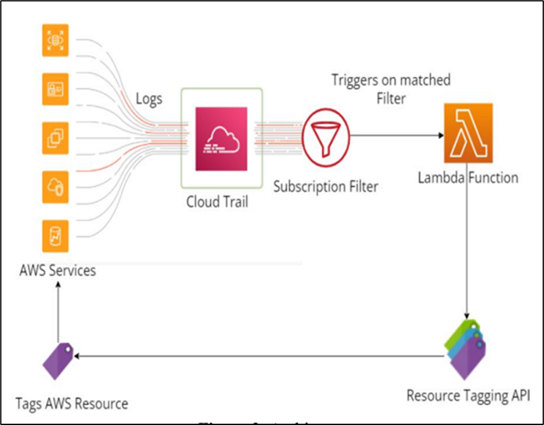
In the realm of resource management, the practice of labeling, ledgering, and tagging has a rich historical legacy that has transcended time, demonstrating its enduring importance. These processes, which have been fundamental since ancient times, continue to wield immense significance in the contemporary context, particularly when applied to intangible assets, which are instrumental in organizational success. However, in the contemporary landscape characterized by digitalization and the proliferation of non-tangible assets, the task of effectively labeling and tagging resources has grown markedly intricate. This complexity is especially conspicuous when considering intangible resources, and it is accentuated within the domain of software infrastructure and application modules. In these domains, the sheer volume of resources in use has burgeoned to unprecedented levels, rendering manual tagging processes not only labor-intensive but also prone to errors and inconsistencies. Moreover, the scope of resource tagging has evolved beyond the rudimentary labeling of resource names, now encompassing a multitude of metadata attributes that impart comprehensive context and information. To tackle these formidable challenges, this paper presents a robust, enterprise-grade solution engineered to automate the resource tagging processes within the Amazon Web Services (AWS) ecosystem. At its core, this solution leverages the capabilities offered by Amazon's CloudTrail services, harnessing them to mitigate the manual burden associated with resource tagging activities...... .
References
[1] J. Bhattacharya, J. Mistri, R. Biswas, D. Dalui, D. Singh, P. Rakshit, S. Bhattacharyya, "A Survey on Data Security and Challenges", International Journal of Computer Sciences and Engineering, Vol.8, Issue.1, pp.49-54, 2020.
[2] Smith, J. (2019). Managing Intangible Assets in the Digital Age. Harvard Business Review, 2019.
[3] Smith, J., Johnson, A., & Brown, L. (2019). Enhancing Multi-Cloud Cost Allocation through Resource Tagging. Journal of Cloud Computing: Advances, Systems and Applications, Vol.8, Issue.1, pp.17, 2019.
[4] Smith, P., & Lee, S. (2020). Automated Resource Tagging in Cloud Environments Using Machine Learning. International Journal of Cloud Computing and Services Science, Vol.9, Issue.3, pp.214-226, 2020.
[5] Brown, M., & Chen, Q. (2018). Resource Tagging for Cost Optimization in Cloud Environments. Journal of Cloud Economics, Vol.5, Issue.2, pp.78-92, 2018.
[6] Johnson, R., Williams, E., & Martinez, M. (2021). Integrating Identity and Resource Tagging for Enhanced Resource Governance. Journal of Cloud Identity Management, Vol.15, Issue.4, pp.112-128, 2021.
[7] Wang, J., Lee, S., Wang, W., & Chen, C. (2016). A survey of cloud resource management for service computing. Future Generation Computer Systems, Vol.56, pp.84-99, 2016.
[8] Buyya, R., Broberg, J., & Goscinski, A. (2011). Cloud computing: principles and paradigms. John Wiley & Sons., 2011.
[9] David Clinton; Ben Piper, "CloudTrail, CloudWatch, and AWS Config," in AWS Certified Solutions Architect Study Guide: Associate SAA-C02 Exam , Wiley, pp.183-210, 2021.
[10] Abbas Kudrati; Chris Peiris; Binil Pillai, "AWS Cloud Threat Prevention Framework," in Threat Hunting in the Cloud: Defending AWS, Azure and Other Cloud Platforms Against Cyberattacks , Wiley, pp.243-319, 2022.
[11] Ewere Diagboya, Infrastructure Monitoring with Amazon CloudWatch: Effectively optimize resource allocation, detect anomalies, and set automated actions on AWS , Packt Publishing, 2021.
[12] M. Sewak and S. Singh, "Winning in the Era of Serverless Computing and Function as a Service," 2018 3rd International Conference for Convergence in Technology (I2CT), Pune, India, pp.1-5, 2018. doi: 10.1109/I2CT.2018.8529465.
[13] J. Dantas, H. Khazaei and M. Litoiu, "Application Deployment Strategies for Reducing the Cold Start Delay of AWS Lambda," 2022 IEEE 15th International Conference on Cloud Computing (CLOUD), Barcelona, Spain, pp.1-10, 2022. doi: 10.1109/CLOUD55607.2022.00016.
[14] Safeer Cm, Architecting Cloud-Native Serverless Solutions: Design, build, and operate serverless solutions on cloud and open source platforms , Packt Publishing, 2023.
[15] H. Puripunpinyo and M. H. Samadzadeh, "Effect of optimizing Java deployment artifacts on AWS Lambda," 2017 IEEE Conference on Computer Communications Workshops (INFOCOM WKSHPS), Atlanta, GA, USA, pp.438-443, 2017. doi: 10.1109/INFCOMW.2017.8116416.
[16] S. Sarbavidya, "Protection of Digital Media using Digital Watermarking", International Journal of Computer Sciences and Engineering, Vol.7, Issue.1, pp.63-66, 2019.
Downloads
Published
How to Cite
Issue
Section
License

This work is licensed under a Creative Commons Attribution 4.0 International License.
Authors contributing to this journal agree to publish their articles under the Creative Commons Attribution 4.0 International License, allowing third parties to share their work (copy, distribute, transmit) and to adapt it, under the condition that the authors are given credit and that in the event of reuse or distribution, the terms of this license are made clear.



