
Automated Health Monitoring System for the Elderly using Internet of Things
Keywords:
Health Monitoring System, Internet of Things, Patient Monitorin, Human Activity RecognitionAbstract
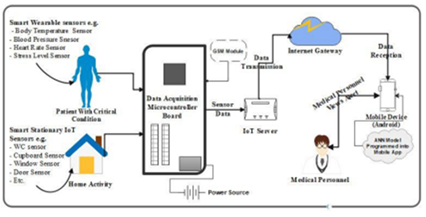
Healthcare delivery in recent years has gained massive improvement. Information Technology has been used to improve the way medical practitioners administer healthcare which has further impacted on the lives of the general populace. This study present an automated system in health monitoring of the elderly. Human Activities Recognition (HAR), heart rate, body temperature, stress level and blood pressure sensor dataset has been used in implementation and a mobile software was developed to simulate the activity, health monitoring and response of the medical personnel to the elderly. The HAR dataset contains 77 sensors in subject 1 and 84 sensors in subject 2. The Agile software development methodology was used in the process of development. The mobile software is used to get the readings of the various wearable and home stationary sensors from which the medical personnel can receive notification of the health information and activity of the patient. The MATLAB scientific programming language has been used to analyze and demonstrate the HAR dataset with some unique activity spikes shown on the graphical illustrations. A mobile application was developed to simulate the readings gotten from the wearable sensors and the activity triggers in the home. The R programming language was used to train and test the wearable sensor performance of the artificial neural model. The body sensor data has been evaluated and analyzed and the performance accuracies are thus: for Heart rate, the performance accuracy recorded for training is 70.4% with a misclassification of 29.6% and testing performance accuracy was 57.4% with a misclassification of 42.4%, Body temperature recorded 65.7% with misclassification of 34.3% for training and 66.7% with misclassification of 33.3% for testing. The performance for Stress level in the training was 65.7% with misclassification of 34.3 and 64.1% with misclassification of 35.9% for testing performance and the performance of blood pressure was 73.1% with a misclassification of 26.9% for training and in testing, 70.4% with misclassification of 29.6% was recorded. The mobile application has performed well during simulation, presenting the readings of the smart wearable devices from the patient and the activities of the patient at home.
References
[1]. Andersson, D., & Nilsson, E. “Internet of Things: A Survey about
Knowledge and Thoughts”, Faculty of Computing, Blekinge
Institute of Technology, SE-371 79, Karlskrona, Sweden, 2018.
[2]. Atzori, L., Iera, A., & Morabito, G. “Understanding the Internet
of Things: Definition, Potentials, and Societal Role of a Fast-
Evolving Paradigm”, Ad Hoc Networks, Vol. 56, pp.122-140,
2017.
[3]. Bangal, S. P., Akshay, N., Shubham, S., & Sameer, M.
“Multipurpose Smart Health Care Monitoring System using IoT”,
International Journal of Information and Computing Science, Vol.
6, Issue 5, pp.60-66, 2019.
[4]. Banka, S., Madan, I., & Saranya, S. S. “Smart healthcare
monitoring using IoT”, International Journal of Applied
Engineering Research, Vol. 13, Issue 15, pp.11984-11989, 2018.
[5]. Bokefode, J. D., & Komarasamy, G. “A Remote Patient
Monitoring System: Need, Trends, Challenges and Opportunities”,
International Journal of Scientific & Technology Research, Vol. 8,
Issue 09, pp.830 – 835, 2019.
[6]. Guan, K., Shao, M., & Wu, S. “A Remote Health Monitoring
System for The Elderly Based on Smart Home Gateway”, Journal
of Healthcare Engineering, 2017.
[7]. Hassan, R., Qamar, F., Hasan, M. K., Aman, A. H. M., & Ahmed,
A. S. “Internet of Things and Its Applications: A Comprehensive
Survey”, Symmetry, Vol. 12, Issue 10, pp.1674, 2020.
[8]. Horváth, I. “Connectors of Smart Design and Smart Systems.
Artificial Intelligence for Engineering Design, Analysis and
Manufacturing”, pp.1-19, 2021.
[9]. Iqbal, N., Ahmad, S., & Kim, D. H. “Health Monitoring System
for Elderly Patients Using Intelligent Task Mapping Mechanism
in Closed Loop Healthcare Environment”, Symmetry, Vol. 13,
Issue 2, pp.357, 2021.
[10]. Iranpak, S., Shahbahrami, A., & Shakeri, H. “Remote Patient
Monitoring and classifying Using the Internet of Things Platform
Combined with Cloud Computing”, 2021.
[11]. Islam, M., & Rahaman, A. “Development of Smart Healthcare
Monitoring System in IoT Environment”, SN Computer Science,
Vol. 1, Issue 3, pp.1-11, 2020.
[12]. Karthi, A., Rajendran, R., & Mathiarasan, P. “Smart Health
Surveillance with Automated Database using Android Mobile
Device”, Brazilian Archives of Biology and Technology, pp.60,
2017.
[13]. Lihua, Z., & Qing, L. “Design and Implementation of Remote
Health Monitoring Sensor Network based on the Internet of
Things”, In AASRI International Conference on Industrial
Electronics and Applications (IEA), pp.332-334, 2015.
[14]. Lv, Z., Xia, F., Wu, G., Yao, L., & Chen, Z. “iCare: A Mobile
Health Monitoring System for the Elderly”, In 2010 IEEE/ACM
Int'l Conference on Green Computing and Communications &
Int'l Conference on Cyber, Physical and Social Computing,
pp.699-705, 2010, IEEE.
[15]. Mohith,M., Naresh, E., & Vijaya K. B. P. “Security and Privacy
in Smart Systems”, Alliance International Conference on
Artificial Intelligence and Machine Learning (AICAAM)', pp.90-
99, 2019.
[16]. Ogunbolu, M., & Fadipe, S. “An Enhanced Remote Monitoring
of Patients Heartbeat and Body Temperature Using Internet of
International Journal of Computer Sciences and Engineering Vol.11(6), Jun 2023
© 2023, IJCSE All Rights Reserved 44
Health Things (IoHT)”, Journal of Science, Engineering,
Technology and Management ISSN: 2795-3955, Vol. 3, Issue 01,
pp.1-11, 2021.
[17]. Pascual, D. G., Daponte, P., & Kumar, U. “Handbook of Industry
4.0 and SMART Systems”, CRC Press, 2019.
[18]. Patel, K. K., & Patel, S. M. “Internet of things-IOT: definition,
characteristics, architecture, enabling technologies, application &
future challenges”, International journal of engineering science
and computing, Vol. 6, Issue 5, 2016.
[19]. Ramamoorthy, S. “Personalized Health Monitoring System Using
IOT and Cloud”, International Journal of Computer Science
Trends and Technology (IJCST), pp.5, 2017.
[20]. Rani, S. U., Ignatious, A., Hari, B. V., & Balavishnu, V. J. “IoT
patient health monitoring system”, Indian Journal of Public
Health Research and Development”, Vol. 8, Issue 4, 2017.
[21]. Romero, M., Guédria, W., Panetto, H., & Barafort, B. “Towards a
Characterisation of Smart Systems: A Systematic Literature
Review”, Computers in industry, pp.120, 2020.
[22]. Russo, G., Marsigalia, B., Evangelista, F., Palmaccio, M., &
Maggioni, M. “Exploring Regulations and Scope of the Internet
of Things in Contemporary Companies: A First Literature
Analysis”, Journal of Innovation and Entrepreneurship, Vol. 4,
Issue 1, pp.1-13, 2015.
[23]. Senthamilarasi, C., Rani, J. J., Vidhya, B., & Aritha, H. “A Smart
Patient Health Monitoring System using IoT”, International
Journal of Pure and Applied Mathematics, Vol. 119, Issue 16,
pp.59-70, 2018.
[24]. Seydoux, N., Drira, K., Garzone, G., Hernandez, N., & Monteil, T.
“Making Smart Knowledge from Not-So-Smart Data”, In Smart
Data Systems and Applications, pp.2p, 2017.
[25]. Sritha, P. & Valarmathi R.S. “A Reliable Remote Health
Monitoring System for Elderly People”, International Journal of
Scientific & Technology Research, Vol. 9, Issue 01, pp.1562-
1565, 2020.
[26]. Wang, H., Zhao, Y., Yu, L., Liu, J., Zwetsloot, I. M., Cabrera, J.,
& Tsui, K. L. “A Personalized Health Monitoring System for
Community-Dwelling Elderly People in Hong Kong: Design,
Implementation, and Evaluation Study”, Journal of Medical
Internet Research, Vol. 22, Issue 9, pp.e19223, 2020.
Downloads
Published
How to Cite
Issue
Section
License

This work is licensed under a Creative Commons Attribution 4.0 International License.
Authors contributing to this journal agree to publish their articles under the Creative Commons Attribution 4.0 International License, allowing third parties to share their work (copy, distribute, transmit) and to adapt it, under the condition that the authors are given credit and that in the event of reuse or distribution, the terms of this license are made clear.



