
Dynamic Core Allocation: Enhancing Fault Tolerance and Energy Efficiency in Cloud Computing
DOI:
https://doi.org/10.26438/ijcse/v11i3.3943Keywords:
Shadow Replication, fault tolerance, Energy ConservationAbstract
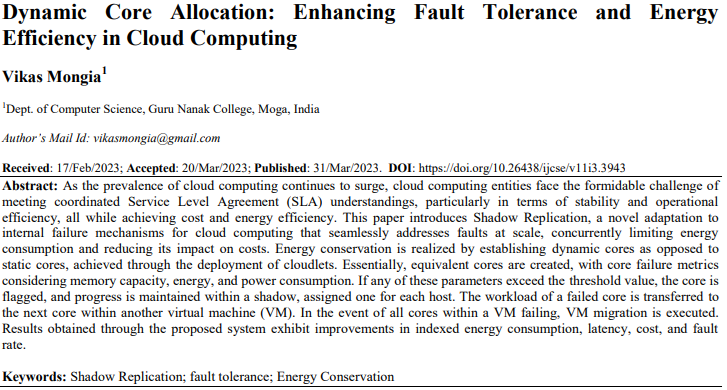
As the prevalence of cloud computing continues to surge, cloud computing entities face the formidable challenge of meeting coordinated Service Level Agreement (SLA) understandings, particularly in terms of stability and operational efficiency, all while achieving cost and energy efficiency. This paper introduces Shadow Replication, a novel adaptation to internal failure mechanisms for cloud computing that seamlessly addresses faults at scale, concurrently limiting energy consumption and reducing its impact on costs. Energy conservation is realized by establishing dynamic cores as opposed to static cores, achieved through the deployment of cloudlets. Essentially, equivalent cores are created, with core failure metrics considering memory capacity, energy, and power consumption. If any of these parameters exceed the threshold value, the core is flagged, and progress is maintained within a shadow, assigned one for each host. The workload of a failed core is transferred to the next core within another virtual machine (VM). In the event of all cores within a VM failing, VM migration is executed. Results obtained through the proposed system exhibit improvements in indexed energy consumption, latency, cost, and fault rate.
References
[1] B. Meroufel and G. Belalem, "Adaptive time-based coordinated checkpointing for cloud computing workflows," Scalable Comput., Vol.15, No.2, pp.153–168, 2014.
[2] D. Kliazovich, P. Bouvry, and S. U. Khan, "GreenCloud: A Packet-level Simulator of Energy-aware Cloud Computing Data Centers," J. Supercomput., Vol.62, No.3, pp.1263–1283, 2012.
[3] B. Alami Milani and N. Jafari Navimipour, "A comprehensive review of the data replication techniques in the cloud environments: Major trends and future directions," J. Netw. Comput. Appl., Vol.64, pp.229–238, 2016.
[4] R. Balamanigandan, "Analyzing massive machine data maintaining in a cloud computing," Vol.23, No.10, pp.78–81, 2013.
[5] D. Singh, J. Singh, and A. Chhabra, "High availability of clouds: Failover strategies for cloud computing using integrated checkpointing algorithms," Proc. - Int. Conf. Commun. Syst. Netw. Technol. CSNT 2012, pp.698–703, 2012.
[6] Y. Zhang, Z. Zheng, and M. R. Lyu, "BFTCloud: A Byzantine Fault Tolerance framework for voluntary-resource cloud computing," Proc. - 2011 IEEE 4th Int. Conf. Cloud Comput. CLOUD 2011, no. July 2011, pp.444–451, 2011.
[7] P. K. Szwed, D. Marques, R. M. Buels, S. A. McKee, and M. Schulz, "SimSnap: Fast-forwarding via native execution and application-level checkpointing," Proc. - Eighth Work. Interact. between Compil. Comput. Archit. INTERACT-8 2004, pp.65–74, 2004.
[8] K. H. Kim and C. Subbaraman, "A modular implementation model of the Primary-Shadow TMO replication scheme and a testing approach using a real-time environment simulator," Softw. Reliab. Eng. 1998. Proceedings. Ninth Int. Symp., pp.247–256, 1998.
[9] K. H. Kim and C. Subbaraman, "An Integration of the Primary-Shadow TMO Replication (PSTR) Scheme with a Supervisor-based Network Surveillance Scheme and its Recovery Time Bound Analysis," Proc. SRDS ’98 (IEEE CS 17th Symp. Reliab. Distrib. Syst. 1998, pp.168–176, 1998.
[10] Hsiao, Hui-I., and David J. DeWitt. "Chained declustering: A new availability strategy for multiprocessor database machines." University of Wisconsin-Madison Department of Computer Sciences, 1989.
[11] M. R. Marty and M. D. Hill, "Virtual hierarchies to support server consolidation," ACM SIGARCH Comput. Archit. News, Vol.35, no.2, pp.46, 2007.
[12] R. T. Kaushik, "GreenHDFS: Towards An Energy-Conserving , Storage-Efficient , Hybrid Hadoop Compute Cluster," HotPower, pp.1–9, 2010.
[13] D. Kliazovich, P. Bouvry, and S. U. Khan, "DENS: Data center energy-efficient network-aware scheduling," Cluster Comput., Vol.16, No.1, pp.65–75, 2013.
[14] Y. Lin and H. Shen, "EAFR: An Energy-Efficient Adaptive File Replication System in Data-Intensive Clusters," IEEE Trans. Parallel Distrib. Syst., vol.28, no.4, pp.1017–1030, 2017.
[15] J. Liu, F. Zhao, X. Liu, and W. He, "Challenges Towards Elastic Power Management in Internet Data Centers," 2009 29th IEEE Int. Conf. Distrib. Comput. Syst. Work., pp.65–72, 2009.
[16] B. Mills, T. Znati, R. Melhem, K. B. Ferreira, and R. E. Grant, "Energy consumption of resilience mechanisms in large scale systems," Proc. - 2014 22nd Euromicro Int. Conf. Parallel, Distrib. Network-Based Process. PDP 2014, pp.528–535, 2014.
[17] A. Odlyzko, "Data Networks are Lightly Utilized, and will Stay that Way," Rev. Netw. Econ., Vol.2, no.3, pp.210–237, 2003.
[18] H.-I. Hsiao and D. J. DeWitt, "A performance study of three high availability data replication strategies," [1991] Proc. First Int. Conf. Parallel Distrib. Inf. Syst., pp.18–28, 1991.
[20] C. S. Shih and T. K. Trieu, "Shadow phone: Context aware device replication for disaster management," Proc. - 2012 5th IEEE Int. Conf. Serv. Comput. Appl. SOCA 2012, 2012.
Downloads
Published
How to Cite
Issue
Section
License
Copyright (c) 2025 Vikas Mongia

This work is licensed under a Creative Commons Attribution 4.0 International License.
Authors contributing to this journal agree to publish their articles under the Creative Commons Attribution 4.0 International License, allowing third parties to share their work (copy, distribute, transmit) and to adapt it, under the condition that the authors are given credit and that in the event of reuse or distribution, the terms of this license are made clear.



